How long does a scuba tank last? Step-by-step calculation
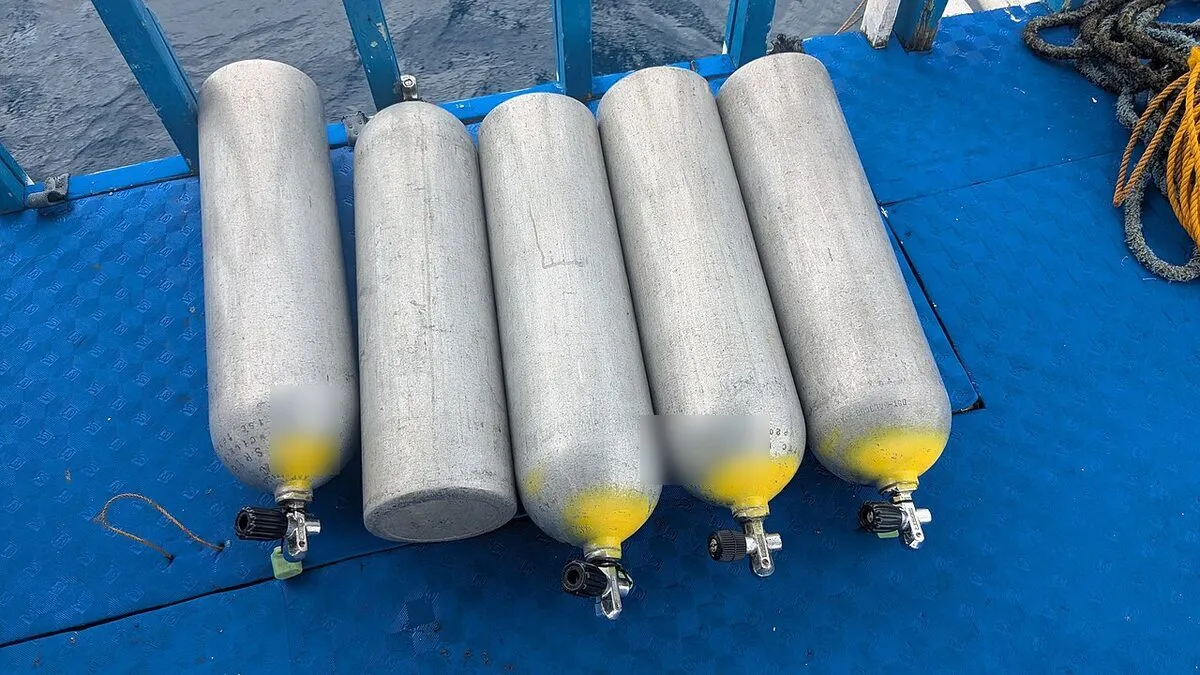
Divide the gas available by what you breathe at the target depth: you get the theoretical duration of a scuba tank, or cylinder. This figure is not the length of your dive, which often ends sooner. This calculation is for understanding, not for planning a dive: the return pressure for your dive is set with your instructor or your dive director (directeur de plongée, the French term).
How do you calculate how long a scuba cylinder lasts?
Divide the usable gas by your consumption at the target depth. The pressure formula comes from Alert Diver (DAN Europe, 23 September 2022). SSI gives the overall relationship in its Science of Diving material (archived page): time = air consumed ÷ (SAC × pressure).
| Step | Formula | Worked example |
|---|---|---|
| 1. Usable gas | cylinder volume × (starting pressure − reserve) | 12 × (200 − 50) = 1,800 L |
| 2. Absolute pressure | 1 + depth ÷ 10 | at 20 m: 1 + 2 = 3 bar |
| 3. Theoretical duration | usable gas ÷ (surface consumption × absolute pressure) | 1,800 ÷ (17 × 3) = 1,800 ÷ 51 ≈ 35 minutes |
Worked example. The 17 L/min is the one from the Alert Diver example, not an average or a benchmark. The 50 bar is an assumption for the calculation, not an instruction.
Step 1 starts from the contents of the cylinder: 12 × 200 = 2,400 litres of air. The 50 bar reserve takes off 12 × 50 = 600 litres, leaving 1,800.
Step 2 explains why depth matters so much. The PADI blog (5 June 2026) gives 2 ATA at 10 m, 3 at 20 m and 4 at 30 m, which are the absolute bar in this table. For the same effort, your consumption at 20 m is therefore three times that at the surface: 17 L/min becomes 51 L/min.
How long does a 6, 12 or 15-litre cylinder last?
Textbook calculation, with the 17 L/min of the Alert Diver example and a 50 bar reserve, between 30 m and 10 m: 13 to 26 minutes for 6 litres, 26 to 52 for 12 litres, 33 to 66 for 15 litres. This is not a dive time.
| 200 bar cylinder | Usable gas | At 10 m (34 L/min) | At 20 m (51 L/min) | At 30 m (68 L/min) |
|---|---|---|---|---|
| 6 litres | 900 L | 26 min | 17 min | 13 min |
| 12 litres | 1,800 L | 52 min | 35 min | 26 min |
| 15 litres | 2,250 L | 66 min | 44 min | 33 min |
Textbook calculation at constant depth, with no descent or ascent, using the consumption of the Alert Diver example and durations rounded down. Replace this consumption with your own. It is not a dive time. At 30 m, the 50 bar of a 6-litre cylinder (300 L) stays below the minimum calculated in the Alert Diver example (552 L). These depths are for the calculation: they do not authorise you to go there. Stay within the limit of your level and the plan set with your supervisor.
Two limits stop you reading this table as a promise:
- The computer can force the end of the dive before the cylinder does. The no-decompression limit is the maximum time at a given depth without a mandatory stop on the way up, and your computer recalculates it during the dive (PADI blog, 28 May 2026). It can arrive while gas remains. It is not a target: the risk of decompression sickness increases as you approach it (Alert Diver, DAN, 7 March 2025). Follow your supervisor’s instruction.
- The same reserve in bar is not the same volume. 50 bar is 300 litres in a 6-litre cylinder and 750 litres in a 15-litre cylinder. Yet Alert Diver counts its reserve in litres: 552 L in its 30 m example, at 15 L/min and before margin. In a 6-litre cylinder, those 552 L would be 92 bar (552 ÷ 6, our calculation), before the 50 to 100% margin it then adds. This figure is not an instruction. So ask your supervisor which return pressure to respect with the cylinder you are using.
The cylinder often comes from the club or the centre: see buying or renting your equipment. Example surveyed on 7 November 2026: the Manta Queen 2 cruise from Khao Lak Scuba Adventures includes 12-litre cylinders and offers 15-litre ones at 2,500 THB per cruise. The rest is costed in the budget of a diving liveaboard, nitrox included.
How do you find your own air consumption (RMV, SAC)?
Measure it after a dive: gas used ÷ (average pressure × duration). This is the Alert Diver formula, in litres per minute. It brings your consumption back to the surface, and this is the figure that goes into the previous calculation.
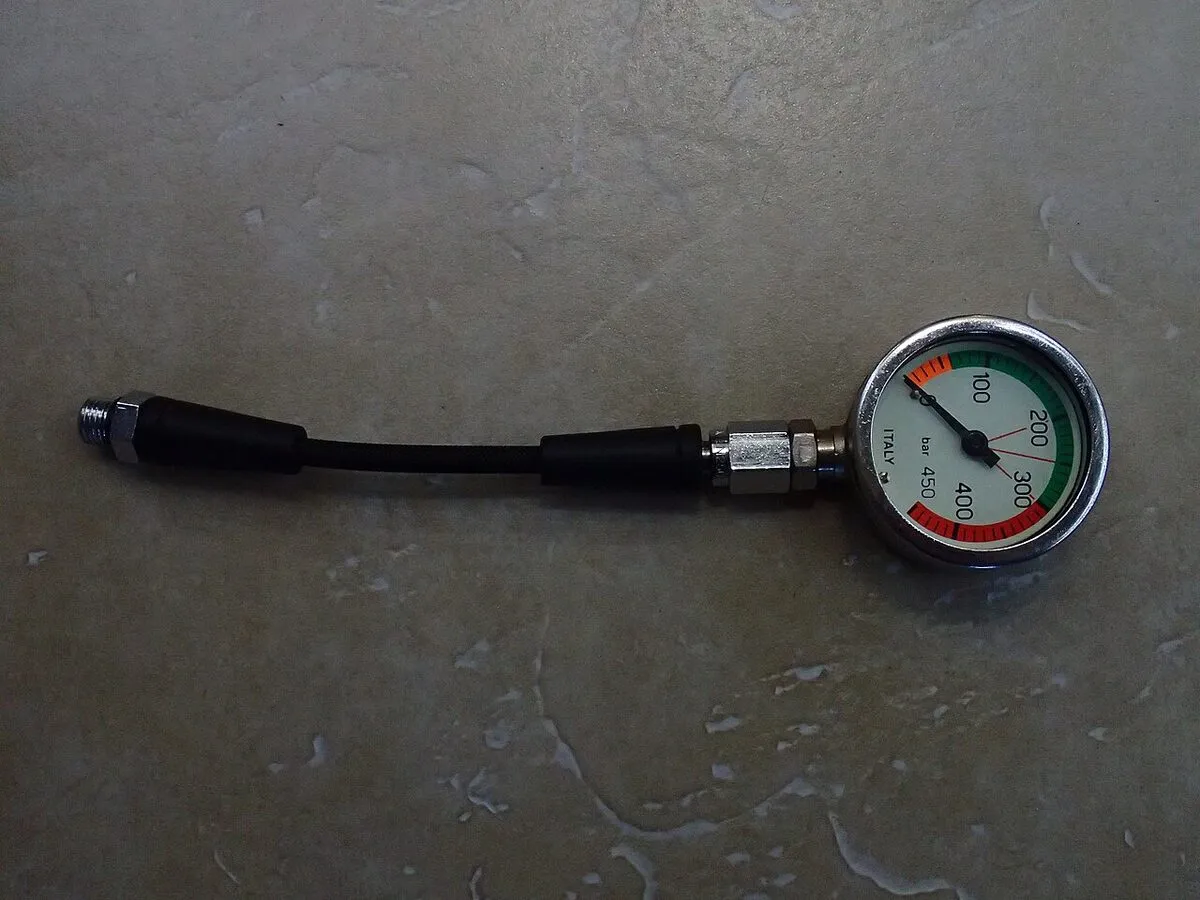
Here is the Alert Diver example: a 45-minute dive with a 12-litre cylinder, from 200 to 60 bar, at an average depth of 12 m.
- Gas used: 12 × (200 − 60) = 12 × 140 = 1,680 L.
- Average pressure: 1 + 12 ÷ 10 = 2.2 bar absolute.
- Consumption: 1,680 ÷ (2.2 × 45) = 1,680 ÷ 99 ≈ 17 L/min.
Four precautions go with this calculation:
- Read the right figures. Alert Diver takes the average depth from the computer’s log. Also note the duration and your starting and ending pressures. On the built-in gauge, see choosing a dive computer.
- Round up. Alert Diver treats 13.4 L/min as 14 L/min, for safety.
- Do not rely on a single measurement. In a document on diving with decompression stops, SSI warns that the SAC calculation is only valid in a controlled environment, with little or no effort, at a single depth. It advises an average of three tests: sustained finning, gentle swimming, stationary. This protocol is covered with an instructor.
- In a team, take the highest value. According to Alert Diver, the team plans on the highest consumption among its members.
This number changes name depending on the source: VRM or VMR (volume respiratoire par minute) in the French edition of Alert Diver, which also cites RMV, SAC and SRC; SAC at SSI.
Why does air consumption vary?
Because it depends on effort, stress and thermal comfort, and it tends to rise when you have not dived for some time. Alert Diver points out that this number is an average, which changes with circumstances. It adds that it ‘also tends to decrease with experience and to increase when a diver has not been in the water for some time’ (same finding at DAN Southern Africa).
A figure measured before a break may therefore no longer hold when you return. Alert Diver asks you to redo this calculation regularly, and no source read puts a figure on the increase. Follow the reserve set by your supervisor, not your old consumption: see getting back to diving after 1 year or more.
Weighting plays a part too. The PADI blog (27 August 2024) writes that the effort of excess weight makes you breathe harder and empties the cylinder faster. This adjustment is made with an instructor: see weighting in scuba diving. If you plan to dive in current, also read drift diving.
Alert Diver adds that low consumption does not make a better diver: this number is discussed at the planning stage, without judgement. So this page gives no technique for breathing less. If your consumption worries you, talk to your instructor.
When you get back to diving, consumption is only one point among others to review with them.
Is the cylinder’s duration the length of the dive?
No: the dive ends at the first limit reached, gas reserve, computer or the dive director’s instruction. In France, it is the dive director who ‘sets the characteristics of the dive’ (French Sports Code, art. A322-72). PADI points out that the pressure gauge is there to end the dive well before you get too low.
The reserve is not a comfort leftover. Alert Diver (23 September 2022) also calls it the ‘minimum gas quantity’ or ‘turn pressure’. It defines it as ‘the cylinder pressure at which you must begin your ascent, at the latest’: this is not the pressure at which you leave the water. At the briefing, ask which of the two your supervisor is announcing. Its principle: ‘every diver must have enough gas to ensure a contingency strategy for themselves and for a buddy’. Two consequences follow:
- The dive ends for the whole group. ‘As soon as one diver in the dive group (palanquée) reaches this pressure, the dive must be ended’ (Alert Diver).
- The reserve is shared. In its 30 m example, DAN Southern Africa (4 December 2022) writes that the 70 bar remaining after a normal ascent are not yours: it is a shared resource.
Alert Diver notes that tradition keeps 50 bar. It nonetheless writes that this reserve ‘is only sufficient for a limited number of potential dives’: ‘relatively shallow dives that do not involve covering long distances’. It therefore calculates the reserve for each dive, then considers a margin of 50 to 100% reasonable. Here are its two examples, with an AL80 cylinder of 11.3 litres:
| Alert Diver example | Calculated minimum | Reserve with the margin |
|---|---|---|
| From a boat, 30 m, square profile | about 50 bar (552 L) | 80 or 100 bar |
| From the shore, wreck at 25 m | a little over 90 bar | 140 bar (50% margin) or 180 bar (100% margin) |
These figures describe those two dives, not yours. For the second, Alert Diver concludes that ‘we cannot count on this contingency strategy when diving with a single cylinder’. The return pressure for your dive is set by your instructor or your dive director, and this method is learned with an instructor.
And the service life of a cylinder?
That is another question: the periodic inspection of the cylinder, which is part of the equipment to service after a break.
To go further, browse all the pages on improving your diving or the free Back in the water check-list.
PDF guide
Getting Back Into Scuba Diving: The Complete 8-Step Guide
PDF guide in 8 chapters for diving again after a year or more: return score, paperwork, theory, skills to revisit, a 3 to 8-week plan and 15 sheets to fill in.
€29
See the guideFrequently asked questions
How long does a 12-litre scuba cylinder last?
There is no fixed duration: it depends on your consumption, the depth and your reserve. With the 17 L/min of the Alert Diver example (DAN Europe, 2022) and a 50 bar reserve, the textbook calculation gives about 52 minutes at 10 m, 35 at 20 m and 26 at 30 m. It is a constant-depth example, not a dive time. Your dive is set with your instructor or your dive director.
How do you calculate how long a scuba cylinder will last?
Work out the usable gas (cylinder volume × pressure available above the reserve), then divide it by your surface consumption multiplied by the absolute pressure, equal to 1 + depth ÷ 10. Example with 12 litres, from 200 to 50 bar, 17 L/min and 20 m: 1,800 ÷ 51, or about 35 minutes. This calculation helps you understand, not plan: planning is learned with an instructor.
How do you calculate your air consumption when diving?
Divide the gas used by the average pressure multiplied by the duration (Alert Diver formula, DAN Europe, 2022). In its example, 12 litres, from 200 to 60 bar, 45 minutes and an average of 12 m give 1,680 ÷ (2.2 × 45), or about 17 L/min. This number is called RMV, VRM or SAC depending on the source. Round it up and redo the calculation regularly.
Why do you use more air at depth?
Because the absolute pressure increases: it equals 1 + depth ÷ 10, so 2 bar at 10 m, 3 at 20 m and 4 at 30 m (Alert Diver; PADI blog, 2026). Your consumption at depth is your surface consumption multiplied by this pressure. For the same effort, it is therefore three times higher at 20 m than at the surface.
What reserve should you keep in your cylinder?
The one in your dive plan, set with your instructor or your dive director, according to the rules of your agency. Alert Diver (DAN Europe, 2022) defines it as the pressure at which you must start your ascent at the latest. So it is not the pressure at which you leave the water. Alert Diver presents 50 bar as the traditional reserve, sufficient for a limited number of dives only, and its two worked examples run from 80 to 180 bar once the margin is added: these figures describe those dives, they are not instructions for you.
How long does a 6-litre cylinder last?
With the 17 L/min of the Alert Diver example (DAN Europe, 2022) and a 50 bar reserve, the textbook calculation gives about 26 minutes at 10 m, 17 at 20 m and 13 at 30 m. It is not a dive time. In a 6-litre cylinder, 50 bar is only 300 litres, whereas Alert Diver calculates 552 litres, before margin, for its 30 m example. Ask your supervisor which return pressure to respect with this cylinder.
Sources
- Alert Diver (DAN Europe), Gas Planning 101: how to calculate your RMV?, Tim Blömeke (23 September 2022, French edition), accessed
- Alert Diver (DAN Europe), Let's talk about… gas planning?, Tim Blömeke (23 September 2022, French edition), accessed
- DAN Southern Africa, Gas Planning 101: How To Calculate Your RMV, Tim Blömeke (4 December 2022), accessed
- DAN Southern Africa, Let's talk about… Gas Planning, Tim Blömeke (4 December 2022), accessed
- SSI, Science of Diving, Air Usage & Supply, Formula To Find Surface Air Consumption Rate (no date shown, archived page judging by its address), accessed
- SSI, document on diving with decompression stops, calculating an average SAC, SSI EMS 202102.14 - 2 (no date shown), accessed
- PADI Blog, Diving Physics: The Science Behind Your Underwater Adventures, Danielle Schofield (5 June 2026), accessed
- PADI Blog, Why Diving Overweighted Is a Bad Idea, Megan Denny (27 August 2024), accessed
- PADI, SPG (Submersible Pressure Gauges) (no date shown), accessed
- PADI Blog, The Science Behind How Dive Computers Work, Megan Denny (28 May 2026), accessed
- Alert Diver (DAN), A Critical Look at No-Decompression Limits, Nick Bird (7 March 2025), accessed
- French Sports Code (Code du sport), article A322-72, in force since 1 April 2012, Légifrance, accessed
- Price survey: Khao Lak Scuba Adventures, Manta Queen 2 (4 days and 3 nights, 10 dives): cylinders included and optional, accessed