Scuba diving weighting: buoyancy check and mistakes to avoid
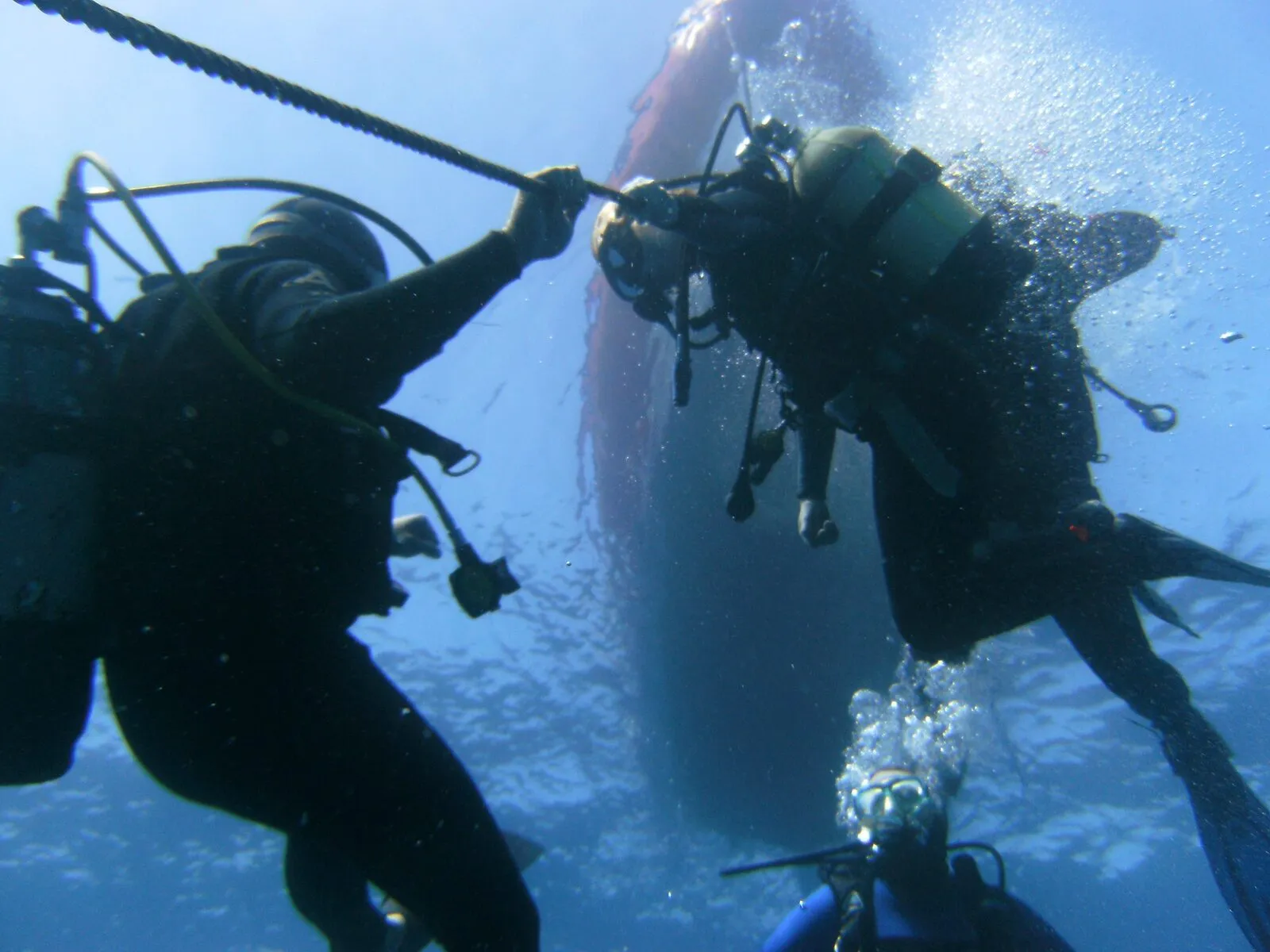
Correct weighting leaves you stable at shallow depth at the end of the dive, with no air in your BCD. Your instructor checks it with you in the water, and no table replaces that check. This page is about scuba diving: freediving has its own weighting rules, which we do not cover here.
What is correct weighting in scuba diving?
Correct weighting lets you float at eye level at the surface with an empty BCD, then leaves you neutral at shallow depth at the end of the dive. Alert Diver (2015) points out that three things affect buoyancy: the BCD, the weights and the volume of your lungs. In France, within the FFESSM federation, you will hear the French term ‘poumon ballast’ (ballast lung) for this role of breathing (Niveau 1 manual, December 2025).
Too much weight. Alert Diver explains that excess weight forces you to inflate your BCD more, which can stop you staying horizontal. Effort rises, and with it gas consumption, which matters for how long a dive cylinder lasts. This effort can also increase decompression stress.
The PADI blog (27 August 2024) gives three signs of excess: you descend faster than the others at the start of the dive, the dive exhausts you, and you add or dump air in your BCD a dozen times or more. It also warns that with too much weight, a failure such as a BCD that no longer inflates can quickly become dangerous.
Too little weight. An underweighted diver can wear themselves out fighting not to rise (Alert Diver). SSI stresses another point: you must be able to stay down for the safety stop, when the cylinder is lighter. Its blog considers it better to have a little more weight at the start than not enough at the end.
These two pitfalls pull in opposite directions. That is why weighting is set in the water, with an instructor, not on paper.
How much lead to start with? The starting points cited by the agencies
No weight is universal: three sources give a starting point as a percentage of body weight, to be adjusted in the water with an instructor. The table lists each one without merging them. Pages re-read on 7 November 2026.
| Source | Date | Suit | Starting point | The source’s caveat |
|---|---|---|---|---|
| Alert Diver (DAN Europe) | 28 June 2015 | 6 mm | 10% of body weight | Only a starting point, to be adjusted by about 1 kg at a time |
| Alert Diver (DAN Europe) | 28 June 2015 | 3 mm | half that | Same caveat |
| PADI blog | 27 August 2024 | 5 to 7 mm full wetsuit | 10% | Estimate for an 11-litre aluminium cylinder in seawater, with 2 kg more to offset its buoyancy at the end of the dive |
| PADI blog | 27 August 2024 | 3 mm | 5% may be enough | Same estimate |
| PADI blog | 27 August 2024 | Drysuit | 15% or more | Same estimate |
| SSI blog | Undated page | Not specified | about 10% | Presented as a general rule, to be confirmed by the check |
Alert Diver and PADI converge on around 10% for a thick suit, and SSI gives the same figure without specifying the suit. That does not mean these sources say the same thing. PADI adds 2 kg for the cylinder. Alert Diver only advises allowing a little more for a partially empty aluminium cylinder.
Do not convert these percentages into weights before you dive: your instructor starts from your equipment and your water, then adjusts with you.
How does an instructor check your weighting?
With a buoyancy check, preferably at the end of the dive, when the cylinder is emptier. SSI writes that this is the best time. The sources do not all describe the same test, though. Here is what each one writes, so that you understand what the instructor is looking for:
- SSI (undated page). In water too deep to stand in, with the BCD fully deflated, the regulator in your mouth and breathing normally, you should float at eye level. After a full exhalation, you should sink.
- Alert Diver (28 June 2015). The same start: out of your depth, BCD empty. On a normal inhalation, the water reaches eye level. As you exhale, you sink just enough for the water to cover your head. The final criterion is read underwater: moving effortlessly at 4.5 m at the end of the dive, with an aluminium cylinder at about 34 bar and the BCD deflated.
- PADI (27 August 2024). At the surface, you float at eye level while holding a full breath, and you sink slowly as you exhale. PADI also describes an end-of-dive check, to be done no deeper than 6 m. It involves a manoeuvre with the weights that we do not describe here: it is only done under supervision.
Two differences stand out: normal or full inhalation, surface or end of dive. The second matters, because a partially empty aluminium cylinder is more buoyant (Alert Diver). A successful check at the start therefore does not guarantee the end of the dive.
These descriptions are not instructions. Your instructor chooses the place, the time and the method. If they find a discrepancy, they adjust in small steps: about 1 kg at a time, according to Alert Diver.
What changes your weighting?
Your suit, your cylinder, the water and your own body weight: redo the check with an instructor as soon as one of them changes. SSI asks for it with every new suit, in every new water, and with a cylinder of a different size or material.
| What changes | Effect | Source |
|---|---|---|
| Thicker suit or drysuit | More weight: a 7 mm suit is far more buoyant than a 3 mm | SSI; Alert Diver (2015); PADI (2024) |
| Cylinder material | An aluminium cylinder needs more weight than a steel one | Alert Diver (2015) |
| Cylinder at the end of the dive | Steel usually stays negative; aluminium can become positive | PADI (2024) |
| Cylinder size | Redo the check; effect not quantified | SSI |
| Seawater or fresh water | More weight in the sea, by an amount that differs for each diver | SSI; Alert Diver (2015) |
| Weight gain | May call for more weight | Alert Diver, Pollock (2012) |
| Body composition | Also plays a part; PADI writes that more body fat calls for more weight | Alert Diver (2015); PADI (2024) |
| Comfort in the water | Most divers need less weight as they relax | Alert Diver, Pollock (2012) |
| New equipment | Get used to it before you use it | DAN |
The suit is often the first change: before buying one, read buying or renting your diving gear. Switching to a thicker suit for cooler water also changes your weighting: set it with an instructor, for example to dive at Belyounech, in the Strait of Gibraltar. The same advice applies to diving along the coasts of Morocco.
Why redo your weighting when you return to diving?
Because your weight, your suit and your reflexes may have changed, and because poor weighting features in an accident report from the French federation.
The FFESSM, France’s diving federation, describes this case in its feedback report 2023 05 (event of 26 May 2023). A diver was returning after more than six months without diving, on a deep dive, without having tested his weighting. ‘Poorly weighted’, he had ‘trouble holding his stop’ and surfaced while his computer still showed a stop. He then suffered decompression sickness. The federation reminds divers to ‘always remember to check your weighting, especially when returning to diving’. Weighting is not the only cause identified: the report also cites fatigue, the diver’s experience, higher gas consumption at depth than planned, a poor understanding of decompression, the effort of holding the stop and a PFO (patent foramen ovale).
Two other sources point the same way:
- FFESSM. In Subaqua (11 May 2026), its president, Frédéric Di Meglio, lists among the aims of a readaptation dive getting used to your equipment again, ‘weighting in particular’.
- DAN. Its skills refresher page (no date shown) lists the buoyancy check, in other words correct weighting, among the skills to practise in confined water before open water. Another DAN page, Return to Diving Safely (no date shown), asks you to familiarise yourself with new equipment before using it.
In practice, ask for this check when you book a PADI, SSI or FFESSM refresher. The full order of steps is in returning to diving after 1 year or more. To pack your bag, see the gear to check over after a break and the free Back in the Water checklist.
Weighting mistakes cited by the sources
Overweighting, not redoing the check after a change, relying on a table found online. Alert Diver (2015) names the first two among common mistakes; the third follows from its own caveats. The fourth, forgetting your buddy’s weights, also comes from Alert Diver.
- Overweighting. Alert Diver lists too much weight among the common mistakes. The PADI blog notes that an overweighted diver often heads straight for the bottom.
- Keeping the same weight everywhere. Alert Diver writes that a diver’s usual weight is not enough on its own: the right weight depends on their condition, their equipment and the location. SSI asks you to redo the check at every change: do it with an instructor.
- Relying on a figure found online. Alert Diver states that its percentages are only a starting point, and SSI speaks of a general rule. Your weighting is established in the water, with an instructor.
- Ignoring your buddy’s weights. Alert Diver considers it essential to check, before every dive, where and how they are fitted. Your weights are set and ditched as your instructor tells you.
To go further, read our page on drift diving or browse all our pages on improving your diving.
PDF guide
Getting Back Into Scuba Diving: The Complete 8-Step Guide
PDF guide in 8 chapters for diving again after a year or more: return score, paperwork, theory, skills to revisit, a 3 to 8-week plan and 15 sheets to fill in.
€29
See the guideFrequently asked questions
How do you calculate your weighting for scuba diving?
No formula gives you your weight: the published percentages are only starting points. Alert Diver (2015) cites 10% of body weight with a 6 mm wetsuit, and PADI (2024) 10% with a 5 to 7 mm full wetsuit, plus 2 kg to offset the cylinder at the end of the dive. SSI gives about 10%, without specifying the suit. The adjustment is then made in the water, in small steps, with an instructor.
How do you know if you are overweighted?
The PADI blog (27 August 2024) cites three signs: you descend faster than the others at the start of the dive, the dive exhausts you, and you add or dump air in your BCD a dozen times or more. Alert Diver (2015) adds that excess weight forces you to inflate your BCD more and can stop you staying horizontal. These signs do not replace a check: ask an instructor for one.
Should you redo your weighting after a break or with a new wetsuit?
Yes. SSI asks you to redo the check with every new suit, in every new water and with a cylinder of a different size or material. After a break, the French federation FFESSM reminds divers to always check their weighting, especially when returning to diving. Do it with an instructor, in a pool or shallow water, before the sea.
Why does weighting change with wetsuit thickness?
Because a thick suit is more buoyant: SSI writes that a 7 mm suit is far more buoyant than a 3 mm one. The starting points follow the same logic: the PADI blog (2024) says 5% of body weight may be enough with a 3 mm suit, cites 10% for 5 to 7 mm and 15% or more in a drysuit, then adds 2 kg for the cylinder. Changing thickness therefore means redoing the check with an instructor.
How much weight for the French Niveau 1?
None of the sources we read gives a weight or a percentage specific to Niveau 1. The manual of the French federation FFESSM (December 2025 version) asks for weighting suited to the environment, fresh or salt water, and to the equipment. It also refers to suitable weighting, with the ‘essential search for balance at 3 m’, and plans to give the student what they need to find their own weighting. Your instructor therefore sets it with you during the course.
What is the difference between scuba weighting and freediving weighting?
They are two separate activities, and the PADI blog devotes a separate article to freediving weighting (8 February 2024). The percentages on this page come from texts about scuba diving: do not apply them to freediving. For freediving, ask a freediving instructor.
Sources
- Alert Diver (DAN Europe), A Question of Weight, Marty McCafferty (28 June 2015), accessed
- PADI blog, Why Diving Overweighted Is a Bad Idea, Megan Denny (27 August 2024), accessed
- SSI blog, How to Perform a Proper Buoyancy Check, Predrag Vuckovic (no date shown), accessed
- Alert Diver (DAN Europe), Practical Thoughts on Fitness and Returning to Diving, Neal W. Pollock (15 January 2012), accessed
- DAN World, Diving Skills Refresher (no date shown), accessed
- DAN World, Return to Diving Safely, Equipment section (no date shown), accessed
- FFESSM, feedback report 2023 05: a chain of incidents leading to decompression sickness (ADD) (event of 26 May 2023), accessed
- Subaqua (FFESSM magazine), Readaptation Diving, Frédéric Di Meglio (11 May 2026, modified 12 May 2026), accessed
- FFESSM, Technical training manual, Plongeur Niveau 1 (PE20), December 2025 version, pp. 4, 6 and 9 (PDF), accessed
- PADI blog, Proper Weighting Techniques for Freediving, Joshua Shankle (8 February 2024), accessed