Diving in the Strait of Gibraltar: currents, traffic, rescue
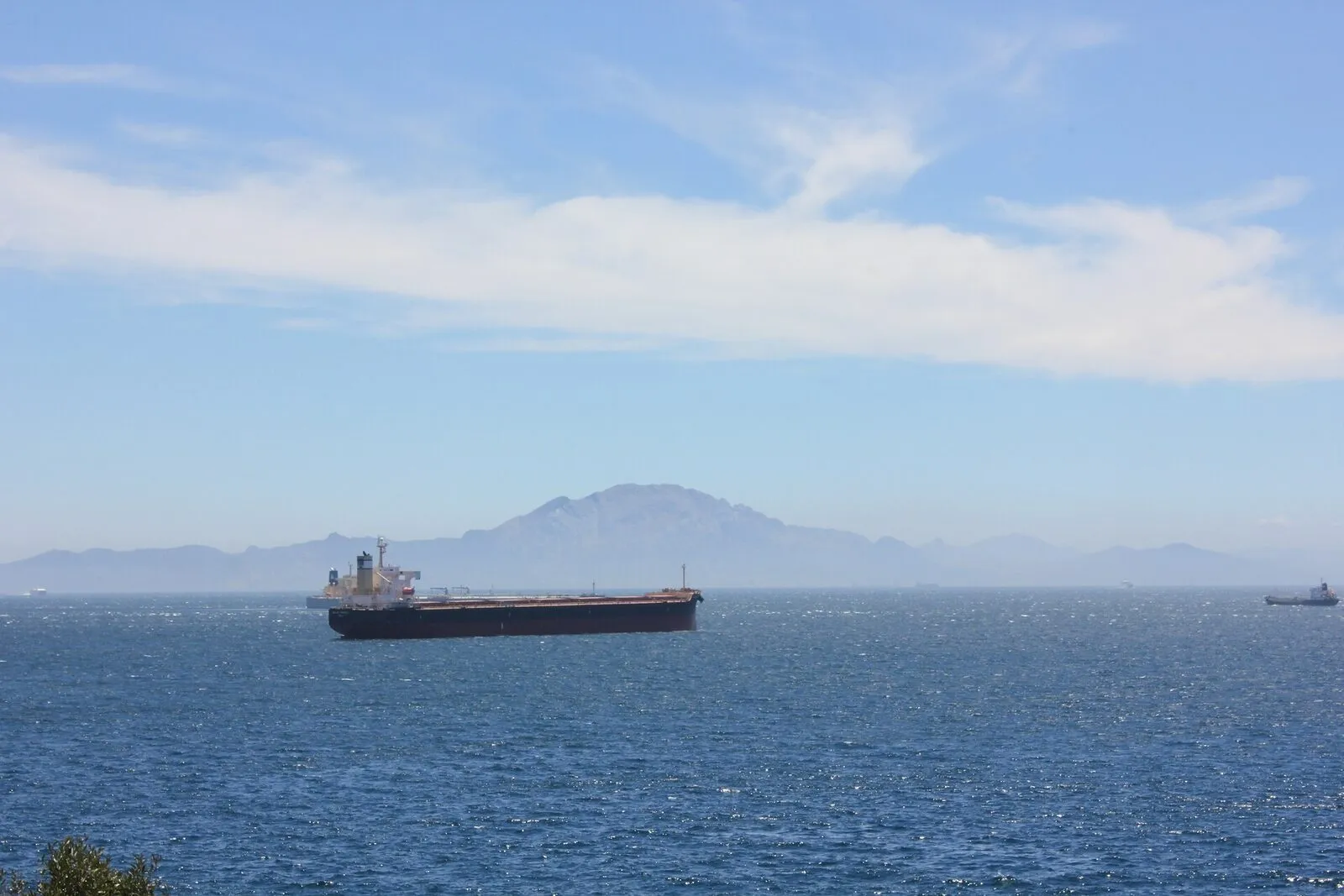
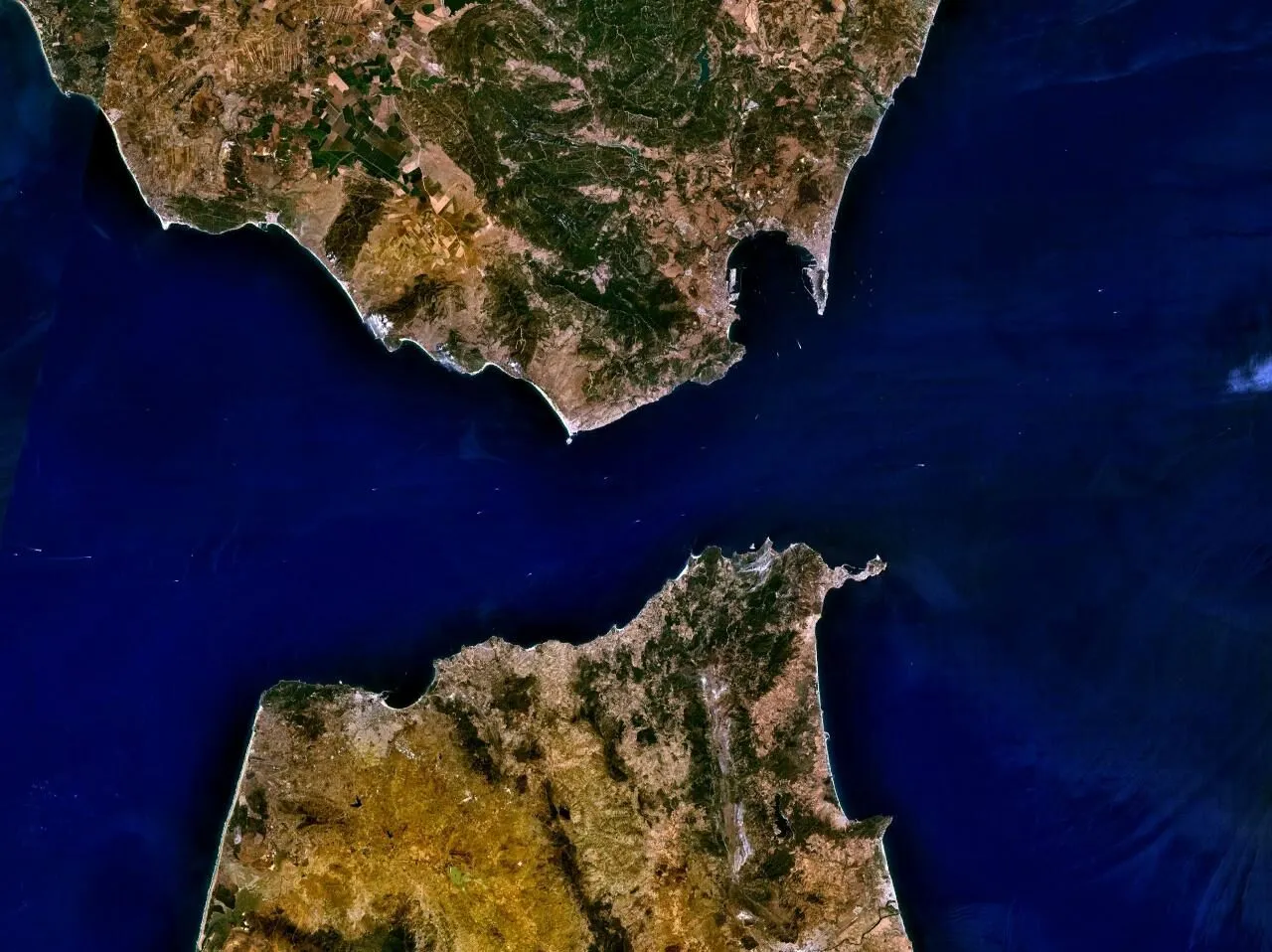
At its narrowest, the strait is 14 km wide, and about 100,000 ships pass through it every year (CNES). The Belyounech centres are based on the Moroccan shore of this strait. No source we read puts a figure on the current on the Moroccan side: this page says what is established, then what to ask. All the pages cited were read on 6 November 2026.
What we know about the strait
The general facts are well documented. None of them describes a dive site.
| Fact | Value | Source, date |
|---|---|---|
| Minimum width | 14 km | CNES (undated, image from 2018) |
| Depth | 300 to 980 m, sill off Tarifa | CNES |
| Traffic | about 100,000 ships a year | CNES |
| Water masses | Atlantic water entering at the surface, Mediterranean water leaving along the bottom | CNES |
| Tide | currents that ‘can be considerable’, above all in the Atlantic | CNES |
| Traffic separation | north lane westbound, south lane eastbound; joint management by Morocco and Spain | CNES |
| Mandatory ship reporting (GIBREP) | adopted on 3 December 1996, in force on 3 June 1997; amended on 17 May 2010, in force on 1 December 2010 | IMO, MSC.63(67), MSC.300(87) |
| Surface water, east of Ceuta (35.875° N, 5.125° W) | 16 °C on 14 February 2025, 23 °C on 15 July 2025 | NOAA OISST, estimate on a 0.25° grid, single-day readings |
Chems Diving advertises 16 to 24 °C at its sites: that is a statement by the centre, not a measurement.
Currents and wind: what no source puts a figure on for Belyounech
No current figure is published for Belyounech in the sources we read. The measurements found come from other points in the strait. Above all they show that the current changes a great deal from one place to another.
| Place | Measurement | Value | Source |
|---|---|---|---|
| Spanish coast, 36°01.64’ N, 5°28.00’ W, 100 m depth (2009-2010) | peaks towards the Mediterranean, at 20 m, in spring tides | average of 1.06 m/s (2.1 knots) over 8 to 9 days, 1.34 m/s (2.6 knots) over 12 h | University of Malaga, 2011 |
| Spanish coast, 36°00.76’ N, 5°31.53’ W, 100 m depth (2009) | same peaks | average of 0.57 m/s (1.1 knots) over 8 to 9 days, 0.55 m/s over 12 h | University of Malaga, 2011 |
| Camarinal Sill, around 5°45’ W | M2 component alone, average over the water column | about 0.7 to 1.1 m/s measured, up to 1.5 m/s in the model, which gives slightly high values (read from a graph). The S2 component adds to it: this is not a maximum | Sánchez-Garrido et al., 2011, fig. 3 |
| Belyounech | current, slack water, favourable hours | not published | no source read |
These averages are not maxima: on the histograms of the same study, isolated peaks reach about 2 m/s (read from a graph).
Three points to remember:
- The current varies quickly in space. The two Spanish moorings are about 5.5 km apart (our calculation from their coordinates), and the average peaks of the first are about twice as strong. They did not measure on the same dates: July to October 2009 for the second, October 2009 to January 2010 for the first.
- The tide dominates. The tidal flux exceeds 5 Sv, against about 0.85 Sv for the average inflow of Atlantic water, and it masks this exchange during a significant part of the cycle. In spring tides, the tidal transport can almost double (Sánchez-Garrido et al., 2011).
- The coast does not automatically protect you. Near Camarinal Sill, at the start of the tidal current towards the Atlantic, the model gives low speeds in the centre and relatively strong ones near the edges, with small eddies (same study).
These figures tell you nothing precise about Belyounech, neither as a ceiling nor as an order of magnitude. The only useful figure is the centre’s, on the day of your dive. See also diving in current: the basic rules.
Wind. No data we read concerns the bay of Belyounech. The Pablo de Olavide University describes, for the levante of the strait, a frequency with no clear trend over a century and a half, with a cycle of about forty years (2019). Chems Diving writes on its site: ‘We rarely cancel due to weather as our location is well-protected’ (read on 6 November 2026). That is a centre’s statement, unchecked. It speaks of weather: its page says nothing about current.
France Diplomatie asks for ‘extreme’ caution when swimming in Morocco, because of the strength of tides and currents (15 September 2026).
Shipping traffic: what it changes for a diver
You do not manage the traffic: the centre chooses the area, and it is for the centre to explain how it takes traffic into account. Stay in the area it has planned.
The CNES places the eastbound flow in the south lane, on the Moroccan side. No source we read gives the distance between the lanes and the Belyounech sites. Chems Diving advertises ‘Minimal boat traffic’ at its sites (read on 6 November 2026). That is a centre’s statement, unchecked: it does not say which boats it means, nor how far the strait’s ships pass. During his stay, the author often saw Moroccan military ships in the bay.
In its 2010 text, the IMO reporting system targets ships of 300 tonnes and over, and a few cases of smaller ships. The Tarifa and Tangier centres follow navigation by radar and AIS, and watch VHF channel 16. This text provides nothing for a diver at the surface.
The rule on the surface marker buoy and line comes from the centre or its federation, never from this site. Their use is learned with an instructor.
If something happens: rescue and hyperbaric chamber
The nearest chamber accessible to a civilian diver is not established as of 6 November 2026. A military medicine entry (status at 29 June 2020) cites three armed forces chambers, in Rabat, M’diq and Al Hoceima, available for diving accidents. It does not say whether they receive civilians. The press of October 2024 also cites a centre at the Cheikh Khalifa hospital in Casablanca: its director says it also intervenes in emergencies, without specifying which ones, and cites diving accidents among the indications for hyperbaric oxygen therapy. No source we read confirms that these chambers receive an injured civilian diver in an emergency, nor at what hours. In 2013, the Ceuta press wrote that the injured of that city were sent to the El Ángel clinic in Malaga. This information is thirteen years old and does not hold for a diver in Morocco.
DAN Europe points out that few chambers are open 24 hours a day, that they must be warned in advance, and that it does not normally provide chamber information in advance (Alert Diver, 2015). The centre’s evacuation plan therefore counts for more than an address.
| Contact | Number | Source |
|---|---|---|
| SAMU (medical emergencies) | 141 | French Embassy in Morocco, 28 April 2026 |
| Civil protection (fire brigade, ambulance) | 15 | French Embassy in Morocco, 28 April 2026; France Diplomatie, 15 Sept. 2026 |
| Police | 19 (in town) or 112 | France Diplomatie, 15 Sept. 2026 (19); French Embassy in Morocco, 28 April 2026 (19 or 112) |
| Royal Gendarmerie, outside built-up areas | 177 | France Diplomatie, 15 Sept. 2026 |
| Tangier university hospital (CHU), public hospital (not a SAMU number) | 06 01 41 99 90 (from a foreign mobile: +212 6 01 41 99 90) | France Diplomatie, 15 Sept. 2026 |
| DAN Europe, international emergency line, 24 hours a day, assistance presented as being for its members | +39 06 4211 5685 | daneurope.org, read on 6 Nov. 2026 |
If you are insured elsewhere, note the emergency number in your contract. We found no emergency number for rescue at sea on the official pages read on 6 November 2026. The centre must tell you whom it calls, and by what means (question 7).
Re-read these numbers on the day you leave. For a life-threatening situation, DAN Europe asks you to call the local emergency services first or go to the nearest hospital, then contact it. France Diplomatie specifies that rescue capacity at sea is often limited, especially in remote regions.
Ceuta is not a default evacuation route. According to El Faro de Ceuta, the Benzú crossing has been closed since 2002, according to number 3 on the IU-Plataforma por la Transparencia list (2015). Access for the residents of Beliones was suspended there in September 2019, and its reopening was still being requested in January 2023. No official source we read gives its state in November 2026: do not count on it. At Tarajal, Euronews reports the crossing of the border by thousands of people on 30 July 2026. The France Diplomatie pages we read do not mention Ceuta. Re-read them before you leave.
Insurance, flying, health
Check that your contract covers diving, evacuation and the chamber: see how to choose diving insurance. Time your flight with the wait before flying after a dive. For your fitness to dive, see a doctor, ideally a diving or hyperbaric physician. A symptom after a dive cannot wait for an appointment: tell the centre at once, call the emergency services and contact your assistance provider.
Questions to ask a strait centre before booking
- What current do you expect at the planned site, and how do you measure it?
- At what time do you dive in relation to slack water?
- What is your rule for the surface marker buoy and line?
- What is the group size, with how many guides?
- What is your evacuation plan: transport, destination hospital, planned chamber?
- How much oxygen do you have on the boat and on the beach?
- Do you have a radio on board, and whom do you call?
- In what case do you cancel for wind, and what happens to my payment?
For diving in Belyounech: season, level, access, safety and diving in Morocco, see our guides, as well as our advice on choosing a dive centre in Belyounech. The method is the same as for the 10 safety questions to ask before paying for a liveaboard.
What our images show
Our images of Belyounech are dated May 2025 by the camera, with medium confidence on the month. They show a rocky seabed, an arch, a passage under rock and a cave. The author dived there, but his account says nothing about current, and these images cannot be used to measure it. Do not infer anything from them for your dive.
PDF guide
Diving in Belyounech, Morocco: the 58-page PDF guide
A 10-chapter PDF guide: measured water and seasons, centres compared with prices in dirhams, Atlantic coast, budget, safety and 10 worksheets to fill in.
€19
See the guideFrequently asked questions
Can you dive in the Strait of Gibraltar?
Yes, centres offer it, notably in Belyounech, on the Moroccan shore. The level required and the conditions for going out depend on the centre. As of 6 November 2026, no source we read describes the current at their sites: ask for it in writing before you book.
Is there current in Belyounech?
No source we read puts a figure on it as of 6 November 2026. The CNES reports tidal currents in the strait that ‘can be considerable’. On the Spanish side, peaks of 0.6 to 1.3 m/s on average, with isolated peaks near 2 m/s, were measured at 20 m in spring tides (2009-2010). These values cannot be transposed to Belyounech: ask the centre on the day of the dive.
Are ships a danger to divers in the strait?
About 100,000 ships pass through every year, according to the CNES. No source we read gives the distance between the dive sites and the shipping lanes. The centre chooses the area: ask it how it takes traffic into account and what its surface signalling rule is.
Where is the nearest hyperbaric chamber to Belyounech?
It is not established as of 6 November 2026. Chambers are cited in Rabat, M'diq, Al Hoceima (military entry, 2020) and Casablanca (press, 2024), but no source we read confirms that they receive an injured civilian diver in an emergency. Ask the centre which chamber it calls, its evacuation plan, the planned hospital and the oxygen available. In the event of an accident, DAN Europe asks you to call the local emergency services first if life is threatened.
Do you need special insurance to dive in Morocco?
France Diplomatie considers a contract covering medical costs, hospitalisation and medical repatriation to be imperative (15 September 2026). Without this cover, access to care may be refused. Check before you leave, in the contract's terms, that yours covers diving, evacuation and the chamber.
Can you go from Belyounech to Ceuta for treatment?
Do not assume so. The Benzú crossing was described as closed since 2002 (2015) and its reopening was still being requested in January 2023. No official source we read gives its state in November 2026. Tarajal saw a massive influx on 30 July 2026. Ask the centre for its real evacuation route, and re-read France Diplomatie before you leave.
Sources
- CNES, The Strait of Gibraltar: a gateway, a bottleneck, a strategic interface (undated page, image of 17 April 2018), accessed
- Calero Quesada et al., Physical Oceanography Group of the University of Malaga, Energy Flux in the Strait of Gibraltar, Martech 2011 (moorings of 2009-2010), accessed
- Sánchez-Garrido et al., Numerical modeling of three-dimensional stratified tidal flow over Camarinal Sill, Journal of Geophysical Research, vol. 116, C12026, 17 December 2011, accessed
- International Maritime Organization, resolution MSC.63(67), adopted on 3 December 1996, accessed
- International Maritime Organization, resolution MSC.300(87), GIBREP system, adopted on 17 May 2010, accessed
- Pablo de Olavide University, climatology of the levante in the Strait of Gibraltar, 15 July 2019 (study published in Atmósfera, vol. 32, no. 3), accessed
- NOAA NCEI, OISST v2.1, daily sea surface temperature, 0.25° grid, via ERDDAP (point 35.875° N, 5.125° W, readings of 14 February and 15 July 2025), accessed
- France Diplomatie, Morocco, Safety, updated 15 September 2026, accessed
- France Diplomatie, Morocco, Health, updated 15 September 2026, accessed
- France Diplomatie, Morocco, Useful contacts, updated 15 September 2026, accessed
- DAN Europe, Emergency page (undated), accessed
- Alert Diver (DAN Europe), Where is the nearest chamber? (4 December 2015); do not reuse the number in this article: the number to use is the one on daneurope.org, accessed
- El Faro de Ceuta, Juanjo Oliva, Ingesa and diving accidents, 4 November 2013, accessed
- El Faro de Ceuta, residents of Beliones and the Benzú crossing, 12 September 2019, accessed
- Euronews, Ceuta border, 30 July 2026, accessed
- Statements: Chems Diving, home page (Belyounech), accessed
- French Embassy in Morocco, In case of emergency, updated 28 April 2026, accessed
- El Faro de Ceuta, IU proposes reopening the Benzú crossing, 11 May 2015, accessed
- El Faro de Ceuta, the PSOE asks for the Benzú crossing to be reopened, 10 January 2023, accessed
- CPM, military-medicine.com, almanac, Morocco, Kingdom of entry (status at 29 June 2020), accessed
- Maroc24, Hyperbaric medicine at the heart of a meeting in Casablanca (meeting of 18 October 2024), accessed
- Le New, The Cheikh Khalifa International University Hospital offers hyperbaric oxygen therapy, 17 October 2024, accessed