PADI vs SSI vs FFESSM: which diving course to choose
The difference lies in the model. The FFESSM is a French federation that trains in clubs: its Niveau 1 makes you a supervised diver to 20 m, with a licence required. PADI and SSI are international organisations whose centres issue the Open Water Diver, for diving with a buddy to 18 m; the CMAS, for its part, links the national federations, including the FFESSM.
Will you mostly dive in France, in a club? The FFESSM Niveau 1 is the most direct route. Are you learning on holiday? A PADI or SSI centre will issue you the Open Water Diver. All three courses lead to a first certification, and crossovers exist between them. The figures below were collected on 1 and 2 November 2026 from the texts of the organisations and of the Code du sport. If you are starting from zero, first read the steps to start scuba diving.
Three systems, two models
On one side, a French sports federation that trains in clubs. On the other, two international organisations that write standards and have centres apply them. The CMAS links the federations together.
FFESSM: a federation, clubs and a licence
You take the FFESSM Niveau 1 in an affiliated club or in a commercial structure approved by the federation. The technical training manual (MFT) for the Niveau 1, in its December 2025 version, sets three entry conditions:
- being at least 12 at the start of training, with the authorisation of a legal guardian for minors;
- holding a valid federal licence;
- presenting a certificate of no contraindication (CACI) that complies with the federal regulations.
The Niveau 1 presentation page on ffessm.fr, dated February 2022, adds the agreement of the centre manager for ages 12-13; failing that, it sets 14.
The Niveau 1 is a certificate for a supervised diver to 20 m (PE20). You dive in a group (palanquée), with a dive-group guide who leads the dive, within an organisation set up by a dive director. For the 2026/2027 season, valid from 1 September 2026, the licence costs €50 for an adult (16 and over) and €31.50 from 12 to 15. Creating the certification card costs €16.
PADI and SSI: standards, independent centres
PADI and SSI do not sell the dives themselves. An affiliated centre and its instructors teach according to the organisation’s standards. The PADI FAQ says so: each PADI centre is independent and sets its own prices. With SSI, the student creates a profile in the MySSI app and chooses a partner training centre.
The first certification is called Open Water Diver at both. It is open from age 10, and the card carries the Junior mention before 15. It includes at least 4 open water dives. Once certified, you dive with a buddy: SSI speaks of a buddy of equal or higher level, at less than 18 m. PADI states that the Open Water Diver is trained to dive to 18 m at most, or to the depth reached in training if it was less.
The CMAS in two sentences
The CMAS (Confédération mondiale des activités subaquatiques, the World Confederation of Underwater Activities) brings together national federations, and the FFESSM is one of its founding members. The FFESSM Niveau 1 is issued with a double-sided FFESSM/CMAS card, which allows you to dive “in more than 100 countries” according to the FFESSM (page of February 2022): that is its figure, not a count published by the CMAS.
The table: FFESSM Niveau 1, PADI Open Water, SSI Open Water
The depths in the table are training and certification limits, not targets. On site, the dive director or the instructor sets the depth of each dive. All sources were consulted on 1 and 2 November 2026; the date in brackets is that of the document when it carries one.
| Criterion | FFESSM Niveau 1 | PADI Open Water Diver | SSI Open Water Diver | Sources |
|---|---|---|---|---|
| Who trains | Affiliated club or approved commercial FFESSM structure | PADI centre, independent | SSI centre chosen in MySSI | MFT N1 (Dec. 2025); PADI FAQ; SSI Open Water page |
| Minimum age | 12, with the authorisation of a legal guardian | 10; Junior card from 10 to 14 | 10; Junior card before 15 | MFT N1 (Dec. 2025); PADI FAQ; SSI EMS |
| Entry conditions | Valid FFESSM licence | Be able to swim, be medically fit, be comfortable in the water | Free MySSI profile; no prior certification | MFT N1 (Dec. 2025); PADI store; SSI Open Water page |
| Medical | CACI under one year old, adults and minors | Medical questionnaire; signed doctor’s approval if an answer is positive | Medical questionnaire; doctor’s authorisation if necessary | MFT General rules (Jan. 2025); PADI FAQ; SSI Open Water page |
| Swimming | No timed test; about 100 m with fins, mask and snorkel and 50 m kitted up | 200 m non-stop (or 300 m with fins, mask and snorkel), no time limit; 10 min of treading water | Assessment of swimming and buoyancy before open water | MFT N1 (Dec. 2025); PADI FAQ; SSI Open Water page |
| Open water dives | About 5 suggested, including 4 to be validated by an instructor (N1 page, 2022); if the certificate is issued in a pool, 4 documented open water dives within 12 months (MFT, Dec. 2025) | 4, usually over 2 days | At least 4, 80 min of bottom time in total | MFT N1 (Dec. 2025); N1 page (Feb. 2022); PADI FAQ; SSI EMS |
| Depth | Supervised to 20 m; learning from 0 to 6 m, then to 20 m under an E2 supervisor | 18 m maximum after certification | Training: 12 m (dives 1 and 2), then 18 m; 12 m for ages 10-11 | MFT N1 (Dec. 2025); PADI blog (May 2024); SSI EMS |
| After certification | In a dive group, with a dive-group guide | With a buddy or a professional | With a buddy of equal or higher level | MFT N1 (Dec. 2025); PADI store; SSI EMS |
| Theory | Oral, during practice, no written exam; online videos in the licence holder’s area | eLearning (readings, videos, quizzes) or manual, with questions at the end of each chapter, then a final exam | Digital kit (6 theory sessions), then a final exam | MFT N1 (Dec. 2025); FFESSM news (Nov. 2025); PADI FAQ; SSI page and EMS |
| ISO 24801-2 standard | Not mentioned in the Niveau 1 MFT | Yes, certificate valid until 15 December 2029 | Yes, in the title of the SSI standard | MFT N1 (Dec. 2025); Austrian Standards certificate (Nov. 2024); SSI EMS |
| Card | Double-sided FFESSM/CMAS, €16 | Open Water Diver, or Junior Open Water Diver | Digital card | FFESSM 2026/2027 fees; PADI FAQ; SSI EMS |
| Indicative duration | Competencies to validate within 15 months at most | Dives over 3 to 4 days if the theory is done by eLearning | 16 to 32 h suggested | MFT N1 (Dec. 2025); PADI FAQ; SSI Open Water page |
The real difference is not the 2 metres between 18 and 20 m. It is the way of diving: the FFESSM Niveau 1 trains a supervised diver, who follows a guide; the Open Water trains a diver who dives with a buddy, in conditions close to their training.
Where will you be recognised?
In France: what the Code du sport says
The Code du sport reasons in aptitudes, not brands. Annex III-14 a describes the PE (supervised diving) and PA (autonomous diving) aptitudes by depth band. Annex III-14 b links the certificates of the FFESSM, FSGT, UCPA, ANMP, SNMP and CMAS to these aptitudes. The Niveau 1 and the CMAS 1 star card both correspond to the PE-20 aptitude. PADI and SSI are not listed (text in force on 1 November 2026, unchanged since April 2012).
In practice, article A322-77 asks you to prove your aptitudes to the dive director, “in particular by presenting a certificate or diploma” (our translation) and, where applicable, your logbook. Failing that, the dive director organises an assessment at the end of one or more dives. An Open Water holder who dives in a French club therefore presents their card and logbook, and it is the dive director who assesses their aptitudes.
Autonomous diving follows another rule. Since 31 October 2025, article A322-73 allows it, on the dive director’s decision, from age 16 to 20 m and from age 17 to 40 m, depending on the aptitudes proven. For the level-by-level detail, see our PADI, SSI and FFESSM level equivalence table.
Abroad: ask the host centre
Outside France, PADI and SSI operate as networks of centres; the CMAS card is the federations’ route. The numbers of countries that circulate on online comparisons do not point to an official dated page: we do not reuse them, apart from the FFESSM figure cited above.
The useful step: before booking, write to the centre where you will dive. Ask which card it accepts and to what depth it takes a diver of your level. On site, the card is only a starting point. On the author’s liveaboard trip to the Similan Islands in December 2025, the photos taken on board show a briefing on a screen, with a diagram of the site, before Elephant Head Rock, Koh Bon or Richelieu Rock. Whatever your card, that local briefing applies to you.
What each route costs on top of the course
The advertised price of a course does not always cover the same items. Here is the cost structure of each route; for the course prices themselves, see our article on the cost of diving training in 2026, item by item.
- FFESSM. The licence (€50 for an adult, €31.50 from 12 to 15, 2026/2027 season) and the certification card (€16). The licence includes third-party liability insurance; personal accident insurance is sold on top (Loisir 1: €25). To compare it with a private offer, read how to choose your diving insurance. You also need a CACI under one year old. The fee detail by age and the validity period are in our page on the price and validity of the FFESSM licence.
- PADI. The online theory has its own price: €253 for the Open Water Diver eLearning on the PADI France store, recorded on 2 November 2026. PADI states that this amount covers the theory only. The in-water training and equipment hire are billed by the centre.
- SSI. The MySSI app is free, but the digital training kit is paid. SSI lists four items, billed separately or together depending on the centre: the training materials, the course and in-water training fees, the open water dives and the certification. Ask the centre for the price of the kit.
Moving from one system to another
Changing route is possible, but not automatic. The conditions below come from the FFESSM crossover pages, dated 28 July 2020.
- PADI or SSI Open Water to FFESSM Niveau 1. You must be at least 14, hold a valid FFESSM licence, and have a copy of the Open Water card and a logbook showing 4 open water dives (they can be done during the course). The medical check follows the MFT. Under the responsibility of an E3 instructor at minimum, you do one technical open water dive and attend a presentation of diving in France and its regulatory framework. The double-sided FFESSM/CMAS card is billed at the current rate (€16 in 2026/2027).
- FFESSM Niveau 1 to SSI Open Water. You must be at least 14, have the Niveau 1 card or certificate and 4 open water dives validated by an instructor. An SSI instructor has you read the manual and take the Open Water tests. The card is billed at the current rate, in Junior version before 15.
- Towards PADI. PADI states that there is no simple equivalence or crossover. A certification from another organisation can, however, often serve as a prerequisite for its next course, the Advanced Open Water Diver.
A crossover is not an administrative formality: it includes an assessment dive or tests, and it does not exempt you from the site briefing. The correspondences beyond the first level are detailed in our level-by-level equivalences between PADI, SSI and FFESSM. To find the line for your certification quickly, use the PADI, SSI and FFESSM level converter. To document your dives, see the dive logbook according to the FFESSM, PADI and SSI.
Which course for your case
| Your situation | Simplest route | What to know |
|---|---|---|
| You will mostly dive in clubs, in France | FFESSM Niveau 1 | Certificate cited by the Code du sport (PE-20); the FFESSM then offers the PE40 and PA20 qualifications of the Niveau 2. |
| You will mostly dive on trips | PADI or SSI Open Water, depending on the centre at your destination | Dives possible in 3 to 4 days with online theory (PADI); ask the centre which card it issues and accepts. |
| Both | Either one, then a crossover | The crossover to the Niveau 1 requires age 14, a licence and an assessment dive. |
| A child or teenager | 10 with PADI and SSI (Junior), 12 with the FFESSM | From 10 to 11: 12 m maximum, with a professional or a certified parent or guardian (PADI), with a professional or a certified adult (SSI). From 12 to 14: 18 m maximum, with a certified adult (PADI); SSI requires a professional or a certified adult up to 15. Youth FFESSM licence: €31.50. |
Two clarifications. If you alternate between club and travel diving with long breaks, keep in mind the PADI, SSI and FFESSM refresher programmes. For a child, the CMAS One Star Diver standard (2023 edition) sets its minimum age at 14: if your child takes the Niveau 1 at 12 or 13, ask the club which card they will receive. Do not try to have them start earlier than the age set by the organisation. See the training courses for children with PADI, SSI and the FFESSM. If you are aiming at becoming an instructor, the question is different and falls outside this page.
In every case, the instructor and the centre weigh more than the logo on the card.
Choose the centre or club before the agency
Whatever the organisation, ask these questions before enrolling:
- Which card will you issue me (FFESSM/CMAS, PADI or SSI), and how soon?
- Is a licence or membership required, and are they included in the price?
- How many open water dives are included, and at which sites?
- How many students per instructor in the water? As a benchmark, the SSI standard sets 8 students per instructor from age 15 and 4 from 10 to 14, more with certified assistants.
- What equipment is provided? PADI advises having at least your own mask, snorkel and fins.
- Is the theory (eLearning, digital kit or course) included?
- Do you offer a crossover to the other system if I need one later?
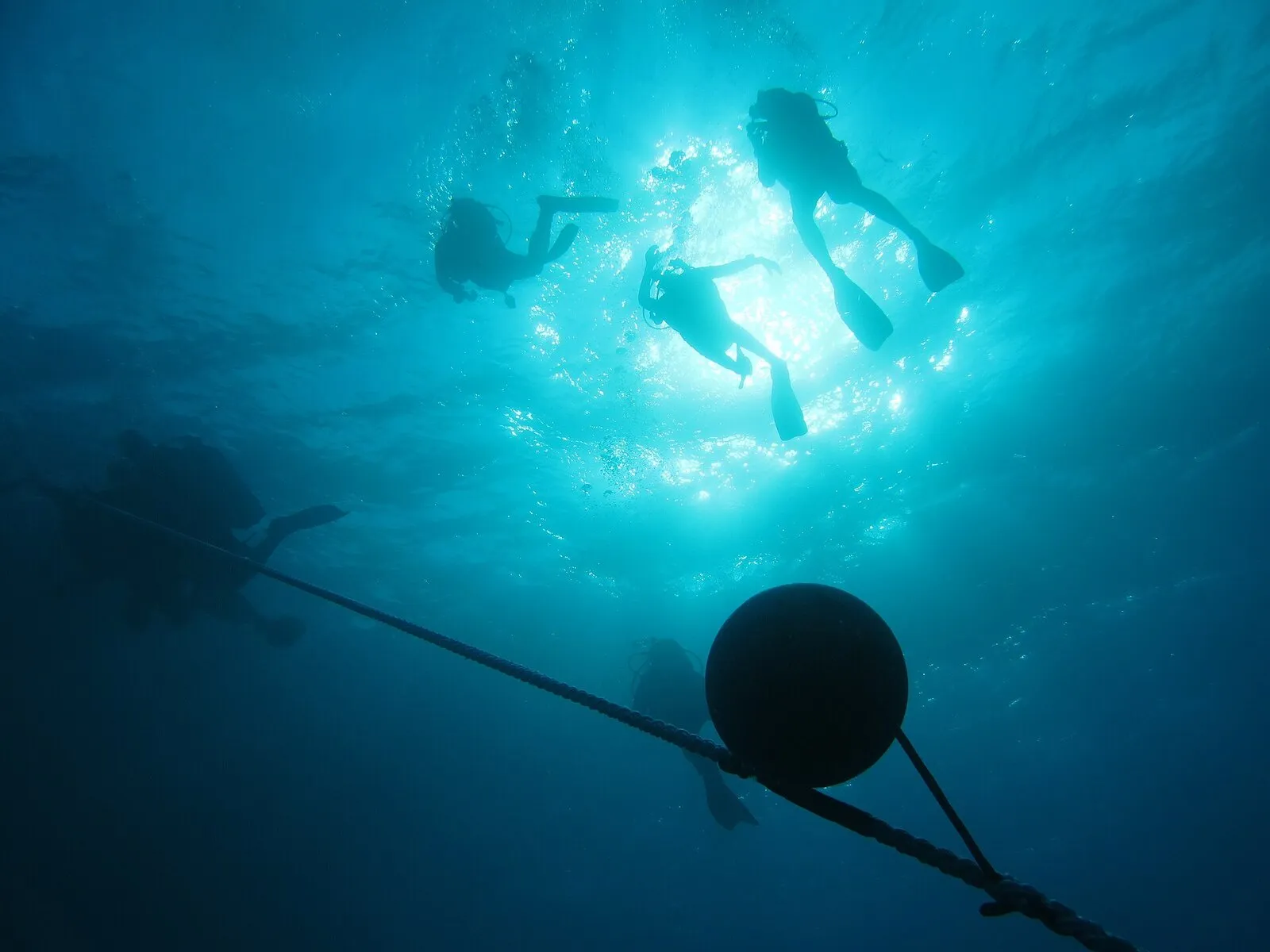
If you are still unsure, trying an introductory dive before choosing an organisation lets you meet the club or centre with no commitment. At the FFESSM, the first scuba immersion of the Niveau 1 is in fact an introductory dive, if you have not already done one (MFT, December 2025).
PDF guide
First scuba certification: €210 to €750 by offer
13-chapter PDF guide: club, centre or holiday, three quotes costed line by line, 15 questions to ask before paying and 12 worksheets to fill in.
€24
See the guideFrequently asked questions
What is the difference between PADI and the FFESSM?
The FFESSM is a French federation: you take your Niveau 1 in an affiliated club or an approved structure, with an annual licence (€50 for an adult in 2026/2027). PADI is an international organisation whose courses are sold by independent centres. The FFESSM Niveau 1 trains a supervised diver to 20 m; the PADI Open Water Diver trains a diver who dives with a buddy, to 18 m (12 m from age 10 to 11).
Are SSI and PADI equivalent, and which should I choose?
For a first certification, the two Open Water Divers are similar: minimum age 10 (12 m maximum up to age 11), at least 4 open water dives, 18 m maximum afterwards and a stated compliance with the ISO 24801-2 standard. PADI points out, however, that there is no simple equivalence or crossover between organisations: a card from another organisation can often serve as a prerequisite for its Advanced Open Water Diver course. The differences lie mainly in the theory material (PADI eLearning at €253 on the PADI France store in November 2026; paid SSI digital kit, billed separately or in a package depending on the centre) and in the centre itself. Choose first the reliable centre where you will dive, then the organisation it teaches.
Is an FFESSM Niveau 1 recognised abroad, and a PADI or SSI certification in France?
The Niveau 1 is issued with a double-sided FFESSM/CMAS card, which the FFESSM presents as valid in more than 100 countries. In France, the Code du sport cites the FFESSM and CMAS certificates, but neither PADI nor SSI: an Open Water holder shows their card and logbook, and the dive director assesses their aptitudes, if need be after an assessment dive. In both cases, ask the host centre which card it accepts.
Can you move from one organisation to another without redoing the whole level?
Yes, through a crossover, from age 14. A PADI or SSI Open Water can obtain the FFESSM Niveau 1 with a licence, 4 documented open water dives, one technical assessment dive and a presentation of the French framework, under the responsibility of an E3 instructor at minimum. PADI, for its part, has no simple crossover: a card from another organisation can often serve as a prerequisite for its next course.
Is the FFESSM Niveau 1 the same as the CMAS 1 star?
The Niveau 1 is issued with a double-sided FFESSM/CMAS card, and the Code du sport links the two certificates to the same aptitude, PE-20: supervised diving to 20 m. Outside France, the CMAS One Star Diver standard provides for dives to 20 m with a diver of the same level, within local rules. The CMAS One Star Diver standard does, however, set its minimum age at 14, against 12 for the FFESSM Niveau 1. If your child takes the Niveau 1 before 14, ask the club which card they will receive.
Do you need an FFESSM licence to take the Niveau 1, and what does it cost?
Yes: the Niveau 1 training manual (December 2025 version) requires a valid federal licence. For the 2026/2027 season, valid from 1 September 2026, it costs €50 for an adult (16 and over) and €31.50 from 12 to 15; the certification card costs €16. Check with the club whether the licence is included in the course price.
Sources
- FFESSM, Technical training manual, Plongeur niveau 1 (PE20), December 2025 version, accessed
- FFESSM, Technical training manual, Federal certificates: general rules (CACI), January 2025 version, accessed
- FFESSM, Plongeur niveau 1 (page of 24 February 2022), accessed
- FFESSM, 2026/2027 fees, valid from 1 September 2026 (PDF), accessed
- FFESSM, PADI to FFESSM crossovers: Open Water Diver / Niveau 1 (28 July 2020), accessed
- FFESSM, SSI Open Water Diver / FFESSM Niveau 1 crossover (28 July 2020), accessed
- FFESSM, FFESSM Niveau 1 / SSI Open Water Diver crossover (28 July 2020), accessed
- FFESSM, The FFESSM Niveau 1 e-learning gets a makeover (14 November 2025), accessed
- FFESSM, N1, N2, N3... What if you chose your own route? (14 October 2026), accessed
- FFESSM, National technical commission: the CMAS (23 June 2019), accessed
- PADI, Become a Certified Scuba Diver: FAQ, accessed
- PADI, Open Water Diver eLearning Course (PADI store), accessed
- PADI, France store (fr-fr), eLearning courses (Open Water Diver price), accessed
- PADI, How Deep Can Open Water Divers vs. Advanced Open Water Divers Go? (updated 30 May 2024), accessed
- PADI, PADI Scuba Diving Restrictions (27 February 2024), accessed
- Austrian Standards plus, ISO 24801-2 certificate for PADI programmes (issued 22 November 2024, valid until 15 December 2029), accessed
- SSI, Open Water Diver (French page), accessed
- SSI, EMS: Open Water Diver (ISO 24801-2), accessed
- CMAS, One Star Diver Standard (2023 BOD 204), accessed
- CMAS, One Star Diver 2023 BOD 204, § 5.1 and § 6.1 (PDF), accessed
- Légifrance, Code du sport, art. A322-71 to A322-101 (A322-73 in force since 31 October 2025, A322-77), accessed
- Légifrance, Code du sport, annex III-14 a (PE and PA aptitudes), in force since 1 April 2012, accessed
- Légifrance, Code du sport, annex III-14 b (certificates and aptitudes), in force since 18 April 2012, accessed