Equalising your ears when diving: what if it hurts?
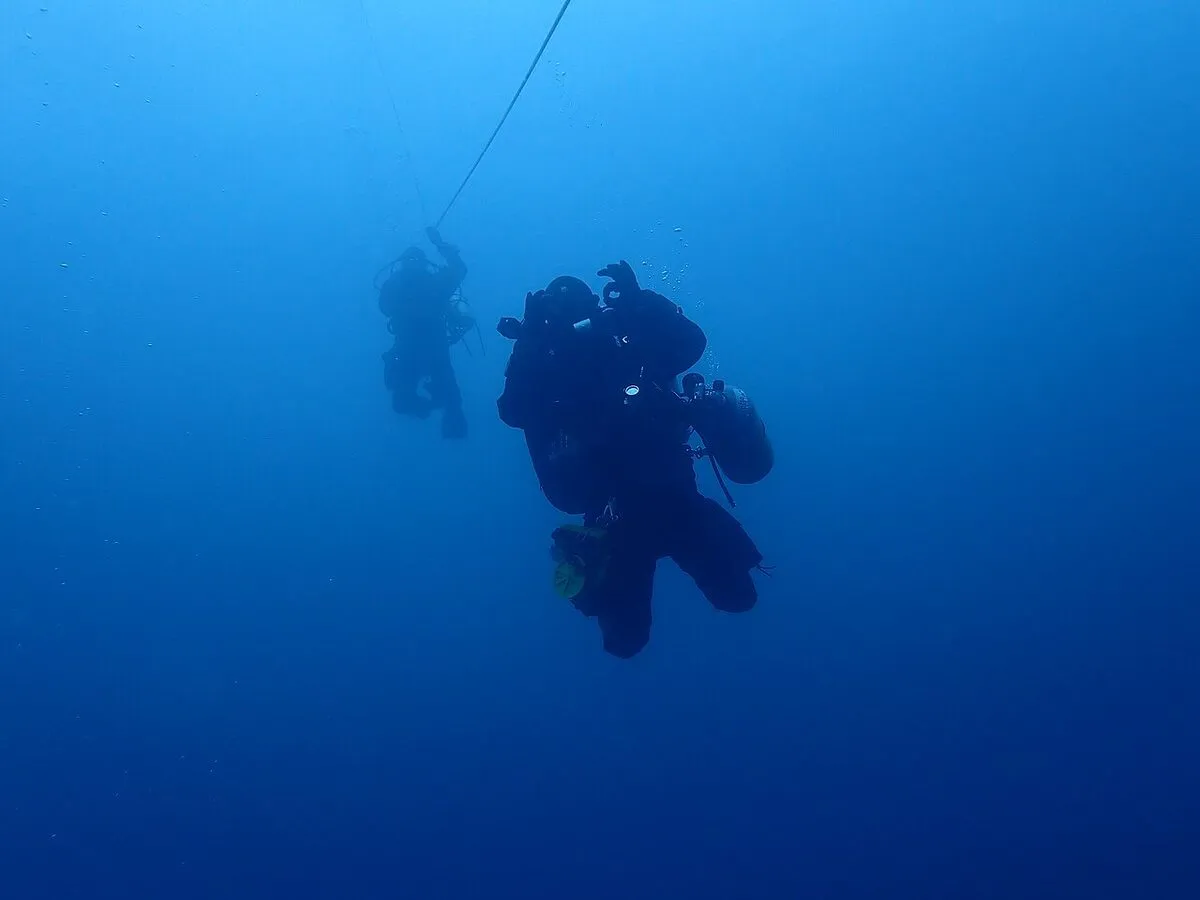
Equalising your ears, or clearing them, means letting air into the middle ear while the water pressure rises. Your instructor will teach you the movement that suits you; this page says when to use it and what should stop you. An earache is never normal when diving.
Why do your ears hurt on the way down?
Pressure rises with depth, and the middle ear equalises only through the Eustachian tube, which you have to open. If this passage stays closed, air no longer gets through (Alert Diver, 2011).
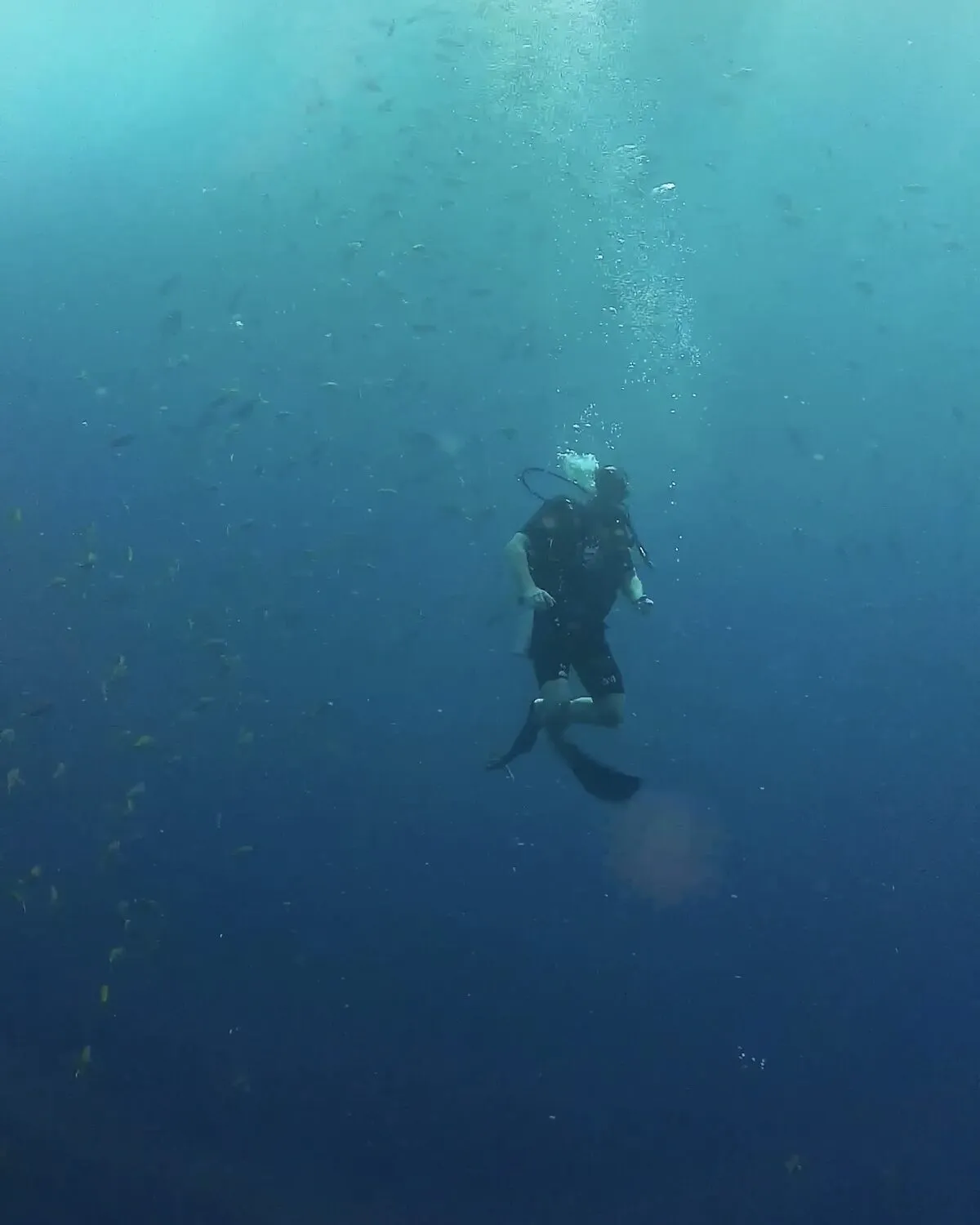
DAN quantifies the difference (Fast Facts guide, undated PDF, uploaded in March 2026 judging by its address): 10% at 1 metre, 20% at 2 metres, where many divers start to feel pain. Beyond that, without equalising, the tubes close and equalising becomes impossible. A try dive, limited to 6 metres in France (Sports Directorate, 25 July 2023; French Sports Code, Code du sport, art. A322-83, version in force since 1 April 2012), goes through this zone.
Ear barotrauma is “the most common accident” in diving (Alert Diver, 2011), “the most frequent diving-related injury” according to the MSD Manual (June 2025). It most often comes from an allergy, a cold or another viral infection; a narrowed Eustachian tube or a deviated nasal septum can also hinder equalisation (Alert Diver, 2011).
When and how to equalise your ears?
Early and often: from the surface, then regularly, without waiting for pain. During a try dive, the instructor shows you how; for what comes next, see how to start scuba diving, step by step and all the pages on starting scuba diving. The advice from the agencies and DAN, in order:
- On days without diving. If you struggle to equalise, PADI (2026) suggests practising on land, gently, twice a day. Have an instructor check your technique first.
- A few hours before. SSI advises equalising every few minutes, starting a few hours before the dive, and checking that you hear a click in both ears when you swallow. Always do it gently (DAN).
- At the surface. Equalise gently: it helps you get past the first metre (SSI) and checks that you can do it (DAN). PADI (2026) asks you to repeat before your head goes under, then just below the surface. “Do not dive if you cannot clear your ears” (Alert Diver, 2011).
- On the descent. Descend feet first (PADI; SSI; DAN), along a descent line (PADI; SSI) or a mooring line (DAN) to control your speed. Look up, it helps open the tubes (PADI; SSI). If only one ear resists, DAN suggests tilting it towards the surface.
Some divers equalise with every breath (PADI, 2026): the idea is to act before the discomfort, not after the pain.
Which equalising manoeuvres do the agencies cite?
Six: Valsalva, Toynbee, Frenzel, Lowry, Edmonds and voluntary opening of the Eustachian tubes. This table reports what PADI, SSI and DAN say about them; it is not a course, and your instructor chooses with you the one they teach you.
| Manoeuvre | The movement, according to the sources | Limit or detail |
|---|---|---|
| Valsalva | Pinch the nose, mouth closed, and blow gently through the nose (Alert Diver; PADI; SSI; DAN) | Never by force: blowing too hard against closed passages can cause barotrauma (PADI). Works only if the tubes stayed open before the pressure change (SSI). |
| Toynbee | Pinch the nose and swallow (PADI; SSI; DAN) | DAN rates it good if equalising is needed on the ascent. |
| Frenzel | Close the nostrils, contract the back of the throat and make a “K” sound (PADI; SSI; DAN) | No limit given by these sources: learn it with your instructor, without forcing. |
| Lowry | Pinch the nose, blow gently and swallow at the same time (PADI; SSI; DAN) | Combines Valsalva and Toynbee: the gentleness rule of the Valsalva applies. |
| Edmonds | Push the jaw forward and down while doing a Valsalva (PADI; SSI); DAN also allows a Frenzel | Same limit as the Valsalva. |
| Voluntary opening of the Eustachian tubes | Contract the soft palate and the throat while moving the jaw forward, as at the start of a yawn (PADI; SSI) | Without pinching the nose (PADI). Takes practice (SSI). |
Sources: PADI blog (updated 9 September 2026), SSI (undated page), DAN Fast Facts guide (undated, uploaded in March 2026 judging by its address), Alert Diver (15 April 2011).
A forced Valsalva is never to be done. Laurie Gowen writes “never perform a forced Valsalva manoeuvre”, and Joel Dovenbarger warns that you risk damaging the middle ear (Alert Diver, 2011). Forced or incomplete equalisation is the usual origin of inner-ear barotrauma (DAN).
If a movement does not work straight away, it is not a failure: many techniques take repetition (DAN). If the difficulties persist, see a doctor, who can refer you to an ENT specialist (PADI, 2026).
What to do at the first discomfort during the descent?
Stop descending, signal to your instructor or buddy, ascend a little, slowly and with them, and try again gently; if it will not clear, end the dive together.
- Stop the descent and signal. For DAN, pain is not acceptable: it signals a descent without enough equalising.
- Ascend a little, slowly and with your instructor or buddy, until the pressure goes away (PADI, 2026): about one metre, or one to two metres, according to Joel Dovenbarger (Alert Diver, 2011), a few metres according to Laurie Gowen (Alert Diver, 2011), “a few feet” (a foot being 30 cm) on DAN’s page, “a few metres” in its Fast Facts guide. Do not aim for a number: ascend just enough for the pressure to go away.
- Try again gently. If the ear equalises without pain, resume slowly, equalising every metre or half metre (Alert Diver, 2011), without going up and down (DAN).
- If it will not clear, end the dive (PADI; DAN; Alert Diver). No dive is worth a barotrauma (SSI). According to DAN, descending without having equalised can ruin a whole trip, or cause lasting damage and permanent hearing loss.
PADI (2026), SSI and DAN describe this fresh attempt. DAN also writes to abort the dive if at any time you have pain, and Alert Diver (2011) to end it “at the first signs of discomfort” in the sinuses or the middle ear. If you have had pain, the most prudent choice is to end the dive.
Dizziness or a sudden loss of hearing underwater: signal straight away to your instructor or buddy, stay with them and end the dive (DAN), ascending slowly, as you were taught. If these signs persist, do not dive again and see a doctor (DAN). When travelling too, at the slightest doubt, do not dive and tell the crew: see safety on the spot in Thailand.
Earache after the dive: what to do?
See a doctor: pain after a dive is not something to manage alone. PADI (2026) writes to always seek medical advice if your ears hurt after diving.
- Pain, blocked ear, crackling. Do not dive again to see whether it passes: DAN asks you not to dive with crackling or a full ear. According to DAN, any doctor can help, and an ENT specialist is best placed.
- Dizziness, nausea or vomiting, loss of bearings, ringing in the ears, hearing loss. DAN describes there a possible inner-ear barotrauma, and its Fast Facts guide classes dizziness, ringing and hearing loss among the serious signs of decompression sickness. Treat them as an emergency: tell the dive director or the crew straight away, who can give first-aid oxygen (DAN), seek medical advice without waiting and do not try to equalise. Pain may be absent, and hearing loss may appear only after a few hours.
- Confusion, loss of consciousness, joint pain. Alert Diver (2011) links them to an air embolism or to decompression sickness. Our instruction: call the emergency services, report the dive and ask for a hyperbaric doctor.
Dizziness and ringing can also come from decompression sickness (Alert Diver, 2011; DAN, Fast Facts), which is not treated in the same way (DAN): always tell the doctor that you have been diving.
At a dive site, tell the dive director or the crew straight away. In France, call 15 or 112; from the coast, 196 or 112; at sea, prefer VHF channel 16 (service-public.gouv.fr, checked on 25 August 2026). Before a trip, note down the emergency number and that of your assistance provider: see how to choose your diving insurance.
Treatment is for the doctor: we give none, and no trick to “unblock” an ear replaces their advice. If a flight is planned, tell them: DAN advises against altitude in case of inner-ear barotrauma.
Resuming diving. DAN writes not to dive again before healing and as long as you cannot equalise properly. For the inner ear, resuming follows the assessment of a doctor experienced in diving medicine. The FFESSM, the French diving federation, classes inner-ear barotrauma and eardrum perforation among the temporary or to-be-assessed contraindications, and the perilymphatic fistula among the permanent contraindications (indicative list, June 2025). For inner-ear barotrauma, marked with an asterisk, the certificate “can only be issued by a specific doctor as defined in the medical regulations”. Tell your doctor what happened and check who can sign: see the diving CACI and the doctor.
Cold, earplugs, hood: what blocks equalisation
A blocked nose or ears, earplugs or a hood that is too tight prevent equalising or create an isolated pocket of air.
- Cold, allergy, blocked nose. Do not dive (DAN). PADI (2026) asks you to wait until you feel better, and Alert Diver (2011) notes that symptoms often come back if you dive again too soon. No trial at sea to see: the detail is in diving with a cold.
- Earplugs. DAN does not recommend any, even vented ones (DAN Southern Africa, 16 September 2023): an earplug traps a pocket of air that the body cannot equalise. The MSD Manual (June 2025) also writes that they must not be used for diving.
- Hood too tight. It can block the water that must reach the ear canal and act “like a suction cup” on the descent, without the diver noticing at first (Claudio Di Manao, Alert Diver, 21 December 2022). This is an article of advice, with no study cited: ask your instructor’s opinion when you try it on.
- Tobacco and alcohol. Avoid before diving (PADI, 2026): they irritate the mucous membranes and increase mucus, which can block the tubes (SSI).
- Water in the mask. It also irritates the mucous membranes; a well-fitting mask limits it (SSI). A flexible nose pocket lets you pinch your nose easily (SSI): see choosing a mask among your first purchases.
PDF guide
Scuba diving questions: levels, health, risks, 11 worksheets
13-chapter PDF guide with 11 worksheets: what each level allows, age, the medical certificate, ears and risks. Every figure is dated and sourced.
€19
See the guideFrequently asked questions
How do you equalise your ears when diving?
Early, often and gently, with the manoeuvre your instructor taught you. PADI, SSI and DAN advise equalising from the surface, descending slowly feet first and carrying on before the pressure starts to hurt. The manoeuvres cited are Valsalva, Toynbee, Frenzel, Lowry, Edmonds and voluntary opening of the Eustachian tubes. Never blow hard.
What should you do if you cannot equalise your ears on the way down?
Stop descending, signal to your instructor or buddy and ascend slowly with them until the pressure eases: about one metre according to Alert Diver (2011), “a few feet” (a foot being 30 cm) on DAN's page, “a few metres” in its Fast Facts guide. Try again gently, without forcing. If the ear still will not equalise, end the dive, as PADI, DAN and Alert Diver ask, and do so together with them.
Earache after a dive: should you see a doctor?
Yes. PADI (2026) writes to always seek medical advice if your ears hurt after diving. According to DAN, any doctor can help and an ENT specialist is best placed. Dizziness, nausea, ringing in the ears or hearing loss are an emergency: tell the crew and seek medical advice without waiting (DAN). Do not dive again before that advice.
Can you dive with earplugs?
No. DAN does not recommend any for diving, even vented ones (DAN Southern Africa, 16 September 2023). An earplug traps a pocket of air that the body cannot equalise, which exposes you to barotrauma, up to a ruptured eardrum. The MSD Manual (June 2025) also writes that they must not be used for diving.
Can you dive with blocked ears or a cold?
No. DAN writes not to dive with congestion, and PADI (2026) to wait until you feel better. If your ears stay blocked after a dive, do not dive again and see a doctor. Do not go to sea to check whether the ear clears.
How do you equalise your ears with a mask on?
The mask covers the nose. PADI (2026) writes to pinch the nostrils or to close them against the mask skirt. SSI advises choosing a mask with a flexible nose pocket so you can pinch your nose easily. Try it before buying and ask your instructor to show you the movement.
Sources
- PADI, blog, Ear Equalization and Ear Care for Scuba Divers, published 22 August 2018, updated 9 September 2026, accessed
- SSI, blog, Dive Health: How to Equalize Ear Pressure (undated), accessed
- SSI, blog, Dive health: how to equalise (French page, machine translation, undated), accessed
- SSI, blog, Scuba gear essentials for new divers (French page, undated), accessed
- DAN, Fast Facts: The Ears & Diving, 9 Tips for Easy Equalisation, DCS Symptoms (undated PDF, uploaded in March 2026 judging by its address), accessed
- DAN, Middle-Ear Equalization (undated page), accessed
- DAN, Middle-Ear Barotrauma (MEBT) (undated page), accessed
- DAN, Inner-Ear Barotrauma (IEBT) (undated page), accessed
- DAN, Inner-ear barotrauma (IEBT), French version of the DAN World site (undated page), accessed
- DAN Southern Africa, Avoid Diving With Earplugs, Leandra Lynn, 16 September 2023, accessed
- Alert Diver (DAN Europe), Ear barotrauma, the most common diving injury, Joel Dovenbarger, 15 April 2011 (French edition), accessed
- Alert Diver (DAN Europe), All about ears, Laurie Gowen, 15 April 2011 (French edition), accessed
- Alert Diver (DAN Europe), Equaleasy: hood and ear equalisation, Claudio Di Manao, 21 December 2022 (French edition), accessed
- MSD Manual, professional edition, Barotrauma overview (French edition), Richard E. Moon, June 2025, accessed
- MSD Manual, professional edition, Ear and sinus barotrauma (French edition), Richard E. Moon, June 2025, accessed
- FFESSM medical commission, Contraindications to scuba diving, indicative list, June 2025 version according to the commission's site (PDF, in French), accessed
- Service-public.gouv.fr, Emergency numbers (checked on 25 August 2026, in French), accessed
- Légifrance, Code du sport, article A322-83 (group of beginner divers, 0 to 6 m), version in force since 1 April 2012, accessed
- French Ministry of Sport, Sports Directorate (Direction des sports), letter to the president of the FFESSM on the try dive (baptême de plongée), 25 July 2023 (PDF, in French), accessed