PDF guide
Filming Underwater: Calculate Storage and Batteries
PDF guide with 12 chapters, 9 worksheets and 6 checklists: read a camera's spec sheet, calculate storage and batteries, back up while travelling, then edit.
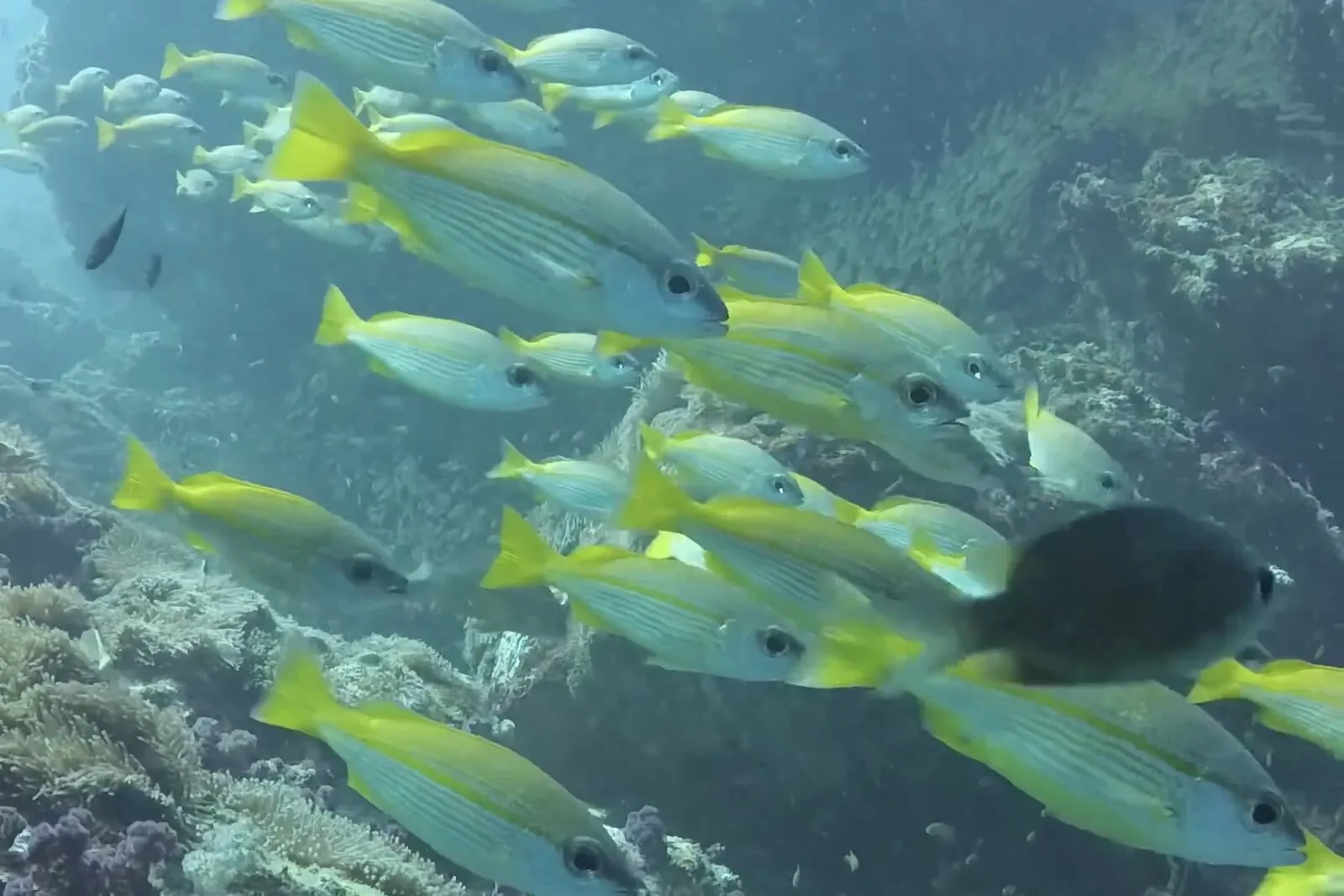
You are leaving with an action camera and you want to come home with footage, without a full card on the third day, without a flat battery and without having made your dive second priority. This guide has you calculate first, film second: read a manufacturer’s spec sheet, decide on the housing and the lighting, work out the storage and the batteries, back up while travelling, then edit. Safety comes before the picture, from the very first chapter.
One figure to begin with. Hugo, a fictional example case, leaves on a liveaboard: 4 days of diving, 5 dives a day, 10 minutes filmed per dive. That makes 20 dives and 200 minutes. At the 48 Mb/s bitrate of one of the author’s 4K files at 30 frames per second, one minute takes up 0.36 GB: 72 GB at 10 minutes per dive, 144 GB at 20 minutes, and 96 or 192 GB with a third of margin. These are calculation scenarios, not averages for divers.
The problem it solves
A camera’s spec sheet states 10 m, 20 m or 60 m, a battery life measured under laboratory conditions, lumens, a resolution: none of these figures tells you how many cards, batteries and backup hours you need for your trip. The guide puts them back in order: what you are allowed and able to film, what each figure really says, what resolution and frames per second cost in storage and battery, and how to lose nothing on the way home.
An example calculated with the guide
Two example cases, fictional, built by the editorial team. They are not testimonials. Both film in 4K at 30 frames per second, at 48 Mb/s. The battery durations use an example battery life of 45 minutes, not that of a model.
| Example case | What they film | Calculated storage | Batteries to take |
|---|---|---|---|
| Camille, from Nantes, 2-day weekend | 3 dives a day, 8 minutes per dive: 6 dives, 48 minutes | 17.28 GB, or 23.04 GB with a third of margin | 2 (24 minutes filmed per day) |
| Hugo, 4-day diving liveaboard, from Lyon | 5 dives a day, 10 minutes per dive: 20 dives, 200 minutes | 72 GB, or 96 GB with margin; 144 GB (192 GB with margin) at 20 minutes per dive | 3 (50 minutes filmed per day); 4 at 100 minutes per day |
The calculation fits on one line: GB per minute = Mb/s × 0.0075, so 0.36 GB per minute at 48 Mb/s and 21.6 GB per hour. The published itineraries of liveaboards in the Similan Islands include up to 4 dives a day: 5 dives a day gives a cautious calculation.
The guide’s contents, in five blocks
- Safety and the rules before the picture (chapters 1 and 2). Five rules that take priority over filming; task overload, with a case published by DAN (a diver who was filming, plan at 30 m, computer at 53 m); talking to your instructor beforehand; the Mu Ko Similan park rule and operator rules; Green Fins; when not to film; what you do not show. Worksheet 1: my filming project. Worksheet 2: my agreement sheet before filming.
- Choosing your camera, your housing and your light (chapters 3 to 5). Four types of camera, without a ranking; ten criteria to read on the spec sheet; reading “10 m” or “20 m”; the total cost. The seal, fogging, rinsing according to the manuals. The pole and the handle; why light is lacking, reading a video light (lumens say nothing about the angle or the battery life), red and magenta filters. Worksheet 3: comparing two cameras. Worksheet 4: my housing logbook. Worksheet 5: my set-up.
- Setting up, storing, powering (chapters 6 to 8). Resolution, frames per second, codecs and bitrate; Camille’s and Hugo’s storage; the length of video on a card of 64 to 512 GB; ten settings to decide on land and white balance underwater; stated battery life against yours, the cold, the number of batteries, charging on board, the light. Worksheet 6: my storage budget. Worksheet 7: my settings sheet. Worksheet 8: my battery and charging plan.
- Backing up, travelling, editing (chapters 9 to 11). Cards, the 3-2-1 rule (three copies, two media, one off site), damaged files, the camera’s clock, position and personal data. Carrying camera, batteries and light on a plane: the 100 Wh and 160 Wh thresholds, and the camera bag checklist. Editing in six steps, colour, stabilisation, formats for social media (a 16:9 film cropped to 9:16 keeps only 31.6% of the width). Worksheet 9: my backup log.
- Mistakes, checklists and appendices (chapter 12). Eleven common mistakes, five checklists (two weeks before, the day before and the bag, before each dive, after each dive, on return), a glossary, the guide’s figures on one page and the sources, dated.
Chapter 1 explains how to use the guide and presents what the author has filmed.
What you receive
| File | Format | What it is for |
|---|---|---|
| The guide | A4 PDF, 59 pages, 12 chapters | reading, calculating, filling in the 9 worksheets and the 6 checklists |
No spreadsheet: the two calculations are done by hand in worksheets 6 and 8. The guide is illustrated with frames taken from the author’s videos and a free image from Wikimedia Commons, credited (Peter Southwood, CC BY-SA 4.0); it can be read on a phone by zooming in on the tables and printed as is on A4. Download after payment, no account needed. No link in the guide is an affiliate link.
What we know about the author’s footage, and what we do not
The author filmed his liveaboard trip to the Similan Islands in December 2025 in 4K at 30 frames per second; his videos from Belyounech (May 2025) are in 2.7K; the clock of his Similan camera was a year out. The guide relies on these file readings and on nothing else: it names no camera model of the author’s, and reports no other opinion, setting or personal incident. The frames taken from his videos illustrate how colours, light and backlighting come out; their site and their depth are not known, and no caption gives them.
Who it is for, and who it is not for
For you if you dive with an action camera, a 360 camera, a waterproof compact or a smartphone in a housing, you want to know what to read on a spec sheet before buying, and you are leaving soon or coming home with footage to sort.
Not for you if you are looking for a ranking, a “best” or a brand (the guide gives none), if you want to learn to adjust your buoyancy or to manage a stop (an instructor), if you dive with a hybrid camera in a dedicated housing and strobes (that equipment is outside the scope), or if you are waiting for permission to dive (a doctor).
Doing it yourself or using the guide
The site has no free article on filming. The battery thresholds on planes, which chapter 10 takes up, are in the article diving equipment on a plane: cabin, hold, batteries. For the rest, you can do it all yourself: the manufacturers’ spec sheets and manuals are public, and the storage formula fits on one line.
| Doing it yourself | With the guide | |
|---|---|---|
| Reading a camera spec sheet | open the manufacturers’ pages, each of which measures under its own conditions | ten criteria, how to read the stated depths and a worksheet to compare two cameras using the same grid |
| Storage and batteries | work out the formula again and guess the battery life | the formula, two worked cases, the margin of a third and two worksheets to fill in |
| Safety | look up the park and operator rules | five rules, a dated example of a park rule and an agreement sheet before filming |
| Backup and clock | improvise on return | the 3-2-1 rule, a backup log and the date to set before leaving |
| Price | €0, and time | €15 |
If you already know how to read a spec sheet and work out a rule of three, the guide mainly brings you the safety framework, the worksheets and the checklists. It replaces neither your camera’s manual nor your instructor.
How the information is checked
The facts were checked against primary sources where they exist: manufacturers’ pages and manuals, DAN, PADI, the MNRE rules summarised by the Tourism Authority of Thailand (official text not read), Green Fins, FOCA (the Swiss Federal Office of Civil Aviation), IATA, CISA, YouTube help pages. Each source appears in an appendix with its reading date, 12 November 2026 for the most part. When a figure is a choice made by the editorial team (example battery life of 45 minutes, bitrate of 48 Mb/s, margin of a third), the guide says so. Our method is described on the Methodology page.
No review or testimonial appears on this page: Camille and Hugo, the guide’s example cases, are fictional and presented as such.
This guide in a pack
The Travel and Film Pack brings together this guide and the guide to travelling by plane with your diving equipment for €19 instead of €30 if you buy the guides separately, that is €11 less (37%). At €19, it costs €4 more than this guide on its own (€15): it is only worth it if you also want the other guide.
Frequently asked questions
Does the guide recommend a camera, a housing or a brand?
No, neither brand, nor model, nor ranking: it never says "buy this one". It teaches you to read a manufacturer's spec sheet (depth without housing, housing, resolution, battery, temperature, weight) and to compare two cameras using the same grid. The spec sheets cited as examples, read on the manufacturers' pages on 12 November 2026, are there to show how to read, not to recommend. No link in the guide is an affiliate link.
Does the guide teach me to dive or to film without risk?
No. It teaches no diving technique: buoyancy, equalisation, and managing depth and stops are learned with an instructor, and it is the instructor who judges whether you can film. The guide never says "you can film". Its chapter 2 sets out five rules that come before the picture (buoyancy under control, buddy, planned depth and endurance, no contact with wildlife, technique learned with an instructor) and points out that a stated waterproof depth is not a permitted diving depth. Any health question is for a doctor, ideally a diving or hyperbaric physician.
Which camera does the author use, and what does he say about his equipment?
The guide names no camera of the author's: its model is recorded in none of the files examined, and the guide invents nothing. It reports what his files establish: a video from the Similan Islands liveaboard trip (December 2025) at 3,840 × 2,160 pixels, at 30 frames per second, at about 48 Mb/s (file examined on 12 November 2026), videos from Belyounech (May 2025) in 2.7K, and a camera clock that was a year out in the Similan Islands, hence the chapter on the date. It reports no opinion, preference or setting of the author's beyond these readings.
Can you film anywhere with a camera?
No, and the guide gives a documented example. In Mu Ko Similan National Park, the underwater camera is reserved for holders of the Advanced Open Water certification or for those with 40 dives, with proof of certification or of an approved underwater photography course on request, no contact with wildlife and at least 2 m above coral heads (MNRE, 22 April 2025, according to the Tourism Authority of Thailand, 6 May 2025; the text of the Royal Gazette was not read). The operator may add its own rules: the guide has you ask for its permission in writing and note it in worksheet 2, "my agreement sheet before filming".
Are the figures up to date?
The version is dated 12 November 2026. The specifications of the cameras, housings and lights were read on the manufacturers' pages that day; the guide allows 12 months of validity for the models and the prices, and the methods for reading, calculating and backing up last longer. The battery thresholds on planes (chapter 10) come from a reading of 7 November 2026: an airline may be stricter. Re-read the manufacturer's page on the day you buy.
Is there a spreadsheet?
No. The two useful calculations are done by hand, with a formula and an example: storage (GB per minute = Mb/s × 0.0075, worksheet 6) and the number of batteries (minutes filmed per day ÷ measured battery life, rounded up, plus one spare, worksheet 8). The guide is an A4 PDF to fill in, on paper or with a PDF reader that lets you annotate.
Can I withdraw or be refunded?
The rules are those in our terms and conditions of sale (Terms page). For digital content, the 14-day right of withdrawal ends at the first download of a file from the kit, if you have asked for immediate access and acknowledged that you lose this right (French Consumer Code, art. L221-28, 13°). As long as you have downloaded nothing, you can withdraw. The legal guarantee of conformity applies in the event of a defect. We offer no commercial guarantee on top.